Showing posts with label Irion (Jimmy). Show all posts

Tuesday, October 1, 2013

Winds don't deter history buffs on LCHS Fall Tour


By Norma Kraemer, LCHS President

The fall Lawrence County Historical Society had a great tour on Saturday, September 28.  The weather was bright and sunny, although high winds followed us on our route.  About 25 people drove to the various locations that started with the Anderson Ranch near Whitewood. 

Whitewood native Elaine Albrandt (left) poses with Hank Frawley (right) in front of her painting of the James Anderson Ranch, drawn from a circa 1890 photo.
We were blessed with Hank Frawley being our host and guide to his great grandparents’ ranch. He has spent the last few decades trying to restore the historic buildings that made up a very successful dairy farm before the turn of the 20th Century.  Most of the restoration is completed, which was aided by Deadwood Historic Preservation grants. 

Touring historic Anderson Ranch near Whitewood
The Anderson Ranch had beautiful stone construction that needed major renovation.  Hank found it better to gut the structures, repair the exterior walls, and redo the interiors.  He talked of the challenges of finding historically accurate materials to do the job right.  He also showed us some of the other artifacts found during restoration and talked of how the location of the ranch has probably been a popular place for human habitation for thousands of years, based on the Indian artifacts found.  Because of the spring that supplies water year round at about 40°F, it made the dairy possible before there was electricity. 

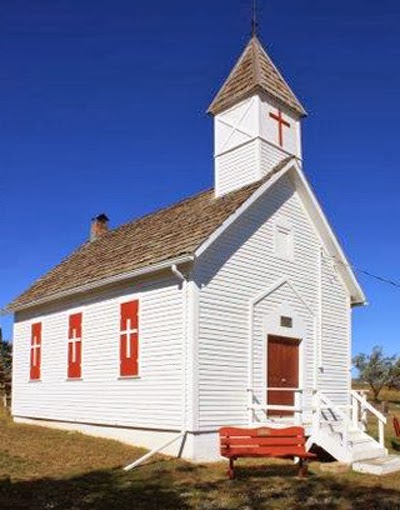
Little Dane Church
After over an hour at the Anderson Ranch we headed to the Little Dane Church to view the historic church and cemetery.  While no longer an active congregation, the church and its well-maintained cemetery are a tribute to the Scandinavian settlers along Dry Creek, south of St. Onge.

We then proceeded to the Minuteman Missile site K-05 as we drove towards St. Onge.  After explaining its significance during the Cold War, Vernon Davis talked about his experiences as a contractor in maintaining the sites. 

Next on the tour was a picnic lunch at the St. Onge City Park.  Thank goodness the park had a windbreak so we had a respite from the wind.  After showing historic pictures of early St. Onge and Vernon Davis talking about what we would be seeing we set out on a walking tour of the town to see what remains today.  


An historic building (1910) in St. Onge
Then we drove up to the Rodeo Grounds to see the tombstone of Jimmy Irons.  Headed back to St. Onge we looked at the abandoned school that had an enrollment at one time of 100 students, the last remaining church, the UCC church and then the city cemetery that has two entrances, one for the Catholics and one for the Protestants.  Vernon Davis had grown up in the area and added unique insights to the area history that is much appreciated. 

After this successful tour, we need to start thinking Spring and where we can go next?  

(Note:  Thanks to Sam Namminga, Mary Gallup-Livingston, and Norma Kraemer for sharing photos!  You'll find a wide array of photographs in our LCHS Gallery)

Wednesday, August 4, 2010

Spring Tour: a few notes and photos

Weather put a damper on plans for the original LCHS Spring Tour in June, but it turned a new leaf in July and provided a very nice day for a tour through several sites in Lawrence and Butte County.

Veteran member Vernon Davis provided the background as a group of morning folks gathered at the Spearfish City Park to begin the tour. Within the park area, there's an old stone grain storage building, artifacts from an old flour mill, a Pioneer Memorial that used to grace downtown Spearfish, and more. Not far from the entry to the park is the site of an old stockade that was built to protect local folks just after the Custer massacre.

                     
Next on the itinerary was St. Onge and the burial site of Jimmy Irion (Iron), the gent hired by the Boughton and Beary Ranch to serve as a lookout against indians while men worked in the nearby hay fields. Irion and several other men were killed by indians on September 10, 1876, and buried atop the bluff where he had died.

A stop at the location of old Minnesela was next, and tour members were able to take a first-hand look at the structure believed to be the only surviving building from the once-thriving community that rivaled Belle Fource as a center of commerce in the area. That building is shown in the photo above at right, as tour members inspected it.

Although we don't have tour day photos from the planned stop at the Center of the Nation Museum and the adjacent log cabin that belong to "Buckskin" Johnny Spaulding, we did click some on a preview trip taken a few months ago. Those preview photos, along with a few others taken by Jerry Bryant during the July 10 tour, can be found in our
Historical Marker Gallery.  One of the most delightful spots on the tour route was Cox's Lake. We extracted the photo shown here from a neat panorama shot that Jerry Bryant took on the day of the tour. It's in the gallery, too. The lake is along the route taken by the Colonel Nelson Cole Expedition of 1865. You can see Crow Peak in the background at right, as Vernon Davis shares information about this site.

As others provide more information -- and any photos -- we'll add them to this location.