Showing posts with label Wharf Resources. Show all posts

Wednesday, December 28, 2011

Case Library at Black Hills State University

A few weeks ago, the Friends of Case Library at Black Hills State University distributed the fall edition of "The Black Hills Historian."  It contains several interesting pieces, including an abbreviated version of the Johnson Siding story that we posted here last week.  The newsletter also offers a variety of helpful tips, including a "Highlighted Resource," which this time focuses upon Lawrence County tax records.  Well worth a visit.  There's also a feature called "Highlighted Collection," which for this issue is described in the article below by Dr. David Wolff and Roberta Sago.  Our thanks to both of them for allowing us to re-print their article here.

 Highlighted Collection:  
Wharf/Bald Mountain Mining Records

The records donated by the Wharf Mining Company deal primarily with the Bald Mountain Mining Company (BMMC), which was organized in 1928 and operated intermittently in the Bald Mountain/Terry Peak areas until 1959. While the company was a late arrival in terms of Black Hills mining history, the ground it worked had been prospected and developed since 1877. In that year, A.J. Smith located the claims that eventually became part of the Bald Mountain Mining Company.

The first actual mining company to precede the BMMC was the Portland Mining Co., organized in 1880, but its production was limited because of difficulties in treating the area’s refractory gold ore. In 1911 the Portland Company purchased the American Eagle Mining Co., including its cyanide mill, and the property was reorganized as the Trojan Mining Co. From that time until 1923, the Trojan company produced about 300,000 ounces of gold. Rising costs caused this company to close, and the property underwent another reorganization, this time as the Bald Mountain Mining Co.  

The new entity did some exploration, but actual production did not begin until 1933 when the government raised the price of gold to $35 an ounce. The increase allowed the company to do well, but only for a time. With the price of gold fixed at $35 an ounce through the 1950s, profits disappeared and the operation closed. The Wharf took control of the property in the 1980s when the federal government stopped regulating the price of gold, and mining again became profitable.

The Wharf Records collection consists of 10.5 cubic feet or records and more than 1,000 mining maps and blueprints.  Materials are dated from 1893-1960 and include:  Balance Sheets1949-1954; Journal dated 1934-1958, recording ore mined, weight, dry, bullion, percent of water, percent of bullion; Invoices 1956-1958, detailing purchase Records, Stock Records of Equipment, List of and location of Equipment on property, Record  of Supplies Purchased from the Company by the miners; Information about other mining companies; BMMC Investigations into other types of ore; Mill performance data; Surveyor’s Log; General Assay Book; Test Notes; Oil Lands and Leases 1897-1920; Uranium, Uranium Mining 1953-1955, Uranium Legislation 1950-1955, Uranium Analysis 1953-1955; Advertising Pamphlets and catalogs; Information on and correspondence concerning new equipment 1934-1958; Personnel Records; Order book; Wage scale; Abstracts of Title; Shipment Statements; Purchase Orders; C.E. Dawson Correspondence, 1937-1948; Traverse Sheets; and Calculation Sheets.

Wharf Resources, Inc. donated these records in 1987.  You can search the inventory of the maps online at:

In addition to the materials donated in 1987, The City of Deadwood Archives donated 28 boxes of materials and nine ledgers to enhance the Wharf / Bald Mountain Mining Records collection.  These documents cover the company history from the 1930s to the 1950s.

NOTE:  Case Library is located on the second floor of the E.Y. Berry Library-Learning Center on the campus of Black Hills State University.  More information about the library can be found at:  Case Library.

Sunday, March 20, 2011

Plight of Terry Cemetery garners statewide interest

It's not a "done deal," but the historic Terry Cemetery appears to have dodged the bullet -- at least for the moment.  The 1.3 acre cemetery is within an expansion area that Wharf Resources hopes to mine for gold over the next few years. 

The South Dakota Board of Minerals and Environment last Thursday (3/17/11) voted to include the cemetery on a list of "Special, Exceptional, Critical or Unique Lands," effectively protecting the cemetery from disturbance by Wharf -- at least until the Board makes a final determination, and that decision may not come for several months.

The cemetery lies adjacent to State Highway 473 about three miles west of Lead on the way to the Terry Peak Lodge and Wharf Resources, but it is hidden from motorists by a wooded hill.

Wharf's plans have attracted considerable media attention, and a story written by veteran capitol reporter Bob Mercer has found ink across the state from Aberdeen and Mitchell to Pierre and Spearfish.

One of the more recent stories regarding the embattled cemetery appeared in the Pierre Capitol Journal last Friday (3/18/11), and you can read it here.  The story was headlined,  "Wharf Official says Terry Cemetery won't be mined."

Friday, March 11, 2011

Terry, South Dakota -- an early view

The following article was originally posted on Black Hills Journal, a web site dealing with both contemporary and historic aspects of the Black Hills region.

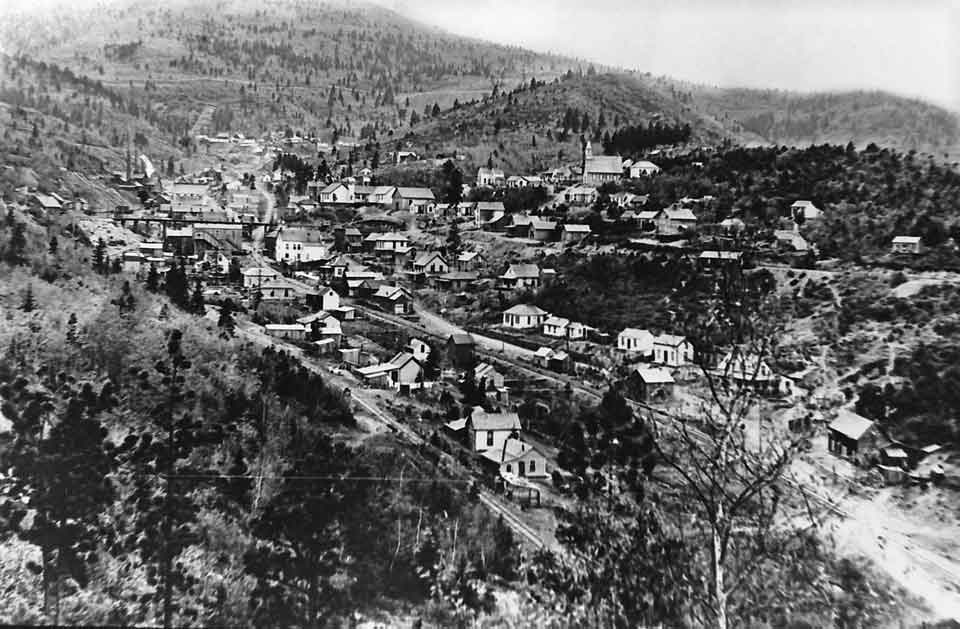
Undated view of Terry, South Dakota
With all the talk lately about the Terry Cemetery, which appears threatened by the planned expansion of gold mining near Terry Peak, we thought it might be of interest to post this photograph from the Lawrence County Historical Society archives.

The undated image -- probably taken at the dawn of the 20th century --  contains considerable detail. It is simply labeled "Terry." As can be seen, Terry was a formidable community, reliant upon the mining industry.  Some of the old  gold mining operations of an earlier era can be seen to the left in the photo.  That's probably the main operation of the Golden Reward Mining Company, which was easily the biggest business in Terry.

Terry was also a stop on the Burlington rail line.

Calamity Jane
In her book Roadside History of South Dakota, author Linda Hasselstrom wrote that  Terry was "home to a thousand people in 1893" and was one of the larger communities of Lawrence County.

If you click on the town photo above, you'll see a larger image, and you'll be able to more clearly see details of the old town, including the steeple of a church climbing skyward in the upper right quadrant.

By most accounts, Martha Jane Cannary -- better known as Calamity Jane -- died in 1903 at the Calloway  Hotel in Terry.  She was 51 years old.   Apparently Jane had requested that she be buried in Deadwood near Wild Bill Hickok, which is exactly what happened.

Some reckon that Hickok probably wouldn't have been too keen on that arrangement.  But for Calamity Jane, it was probably just as well.  Otherwise, she might have been buried in Terry, meaning that she could be uprooted anyway, if Wharf Resources chooses to go after the gold they believe is underneath the old Terry Cemetery.

Terry Cemetery
Disturbing the old cemetery at Terry.......now THAT is something many folks might consider a real calamity.

There are at least 120 souls who "went to their final resting place" at Terry Cemetery.  Although less than a couple of hundred yards away from Nevada Gulch Road (State Highway 473), the cemetery is hidden by a steep hill that runs adjacent to the busy road.  Workers on their way home from a day at Wharf Resources -- and skiers on their way to Terry Peak Lodge -- are likely oblivious to the existence of this historic little cemetery.

If you have information or photos about the old town of Terry that you'd like to contribute, please contact us at Black Hills Journal.

Monday, January 10, 2011

Journal story confirms Wharf's position

Following up on an earlier story, Rapid City Journal reporter Kevin Woster has interviewed a few folks with different perspectives on the proposed expansion of gold mining near Terry Peak by Wharf Resources.  His article, Terry Cemetery move unlikely in near-term mining expansion, appeared yesterday (1/9/11) in the Rapid City Journal.

Rapid City Journal photo by Kristina Barker
Comments attributed to Wharf general manager Bill Shand reaffirmed what LCHS President Jerry Bryant was told by Shand earlier in the week:  moving the Terry Cemetery is "unlikely" within the next five years.

Woster also contacted Jolene Rantapaa, Secretary of the Terry Cemetery Association, whose comments give rise to another sticky question:  if Wharf doesn't move the cemetery, how can the dwindling membership and resources of the cemetery association continue to maintain the remote cemetery?  It's a question that looms for other old cemeteries in similar circumstance across Lawrence County and elsewhere.

Already chafing from having lost historic buildings and artifacts to the Wharf gold mining operations in the Terry and Trojan vicinities, the Lawrence County Historical Society board of directors met last week to explore ways that the society might assist with the preservation and maintenance of county cemeteries that are struggling.

The LCHS board will convene again in a few weeks to further examine -- among other things -- what steps it might be able to take regarding cemeteries.  The group is scheduled to meet at 3:00 p.m., Friday, February 25th, 2011, in the LCHS Room of the newly-completed Homestake Adams Research and Cultural Center (HARCC) in Deadwood.  

Monday, January 3, 2011

Bryant: "No Emergency" at Terry Cemetery

It appears that there is no imminent threat to the Terry Cemetery.

LCHS President Jerry Bryant spoke today (1/3/11) with Wharf Resources General Manager Bill Shand, who said he believes Wharf has no plans to do anything with the old cemetery for at least the next five years.

Wharf had filed documents with the South Dakota Department of Environment and Natural Resources on September 27th, indicating their intention to significantly expand their large scale gold mining operation near Terry Peak. (See our story of 12/25/10:  Terry cemetery area targeted.)  If approved, Wharf would expand its heap-leach gold mine operation by some 600 acres, including the old Golden Reward mining area.  The Terry Cemetery was included in their request for “Determination of Special, Exceptional, Critical or Unique Lands” submitted to DENR.

Shand told Bryant that, if and when Wharf decides to do anything with the cemetery – which “he doubts” – they will give “ample” notice to LCHS and other interested parties.

After talking with Shand and State Archaeologist Mike Fosha about the cemetery, Bryant said it would appear there is no emergency regarding possible disturbance of the cemetery. 

“But it never hurts to be prepared, and we’ll have our ducks in a row to combat it, whether it’s at Terry Cemetery or some other cemetery,” said Bryant. 

At least one individual plans to submit a nominating petition to include the cemetery on the preliminary list of “Special, Exceptional, Critical, or Unique Lands.  Jeannine Guern, who is active with both the Black Hills Pioneers and LCHS, plans to file her document with DENR before the January 11th deadline.

Cemetery preservation and maintenance is on the agenda for the LCHS Board of Directors when they meet tomorrow afternoon (1/4/11) in Deadwood.  The 4 o’clock meeting will take place at the Deadwood City Library.

The Board is also expected to discuss and take action regarding a contract with the Adams Museum and House, establishing the “terms and conditions” for use of the designated “LCHS Room” in the new Homestake Adams Research and Cultural Center.  LCHS earlier approved spending $15,000 to gain space “in perpetuity” in the nearly-completed HARCC, which is located at 150 Sherman Street in Deadwood. 

Construction on the structure is all but complete, and efforts are underway to outfit the facility.  A grand opening celebration is slated for Thursday, June 16th, 2011.

Saturday, December 25, 2010

Terry Cemetery area targeted


With gold prices nearly double what they were 10 years ago, Wharf Resources indicates they're moving forward with plans to expand their mining operations near Terry Peak -- and that could have implications for the Terry Cemetery.  

Although Wharf started its application process in September, it's been pretty much under the radar ever since.  That is, until a story by Kevin Woster emerged last week in the Rapid City Journal.  Woster wrote that the proposal "worries some nearby landowners and could force the relocation of more than 200 graves in the Terry Cemetery."

Above is a bit of history regarding the Terry Cemetery as depicted in the LCHS 1994 publication "Cemeteries and Graves in Lawrence County and Environs," edited by Irma Klock.

We suspect Wharf's proposal will gain additional attention in coming days as folks have an opportunity to comment on their plan.  If you wish to be heard, you should act by Tuesday, January 11th.  For a wealth of information -- and an opportunity to comment -- go to the South Dakota Department of Environment and Natural Resources web site.

As a sidebar, we are reminded of the appropriate steps taken some years back by Hershey Food Corporation when they discovered an old cemetery on land they were preparing to convert to a parking lot near their west plant in Hershey, Pennsylvania.  As it turns out, it was an old Hammacher family cemetery, ancestors of many Hamaker families now living in western South Dakota and western Nebraska.  Hershey stepped up to the plate and did the right thing by taking leadership in helping to preserve this historic cemetery.  We believe their actions serve as a model of corporate and civic responsibility.  
We hope Wharf Resources will display the same kind of leadership, but a public nudge in that direction might help.