Showing posts with label Kraemer (Norma). Show all posts

Monday, September 22, 2014

Railroading highlights the fall meeting of LCHS

by Larry Miller

Reed Richards
More than 50 people gathered yesterday (9/21/14) at the Homestake Adams Research and Cultural Center in Deadwood for the fall meeting of the Lawrence County Historical Society.  Balmy weather, a program about railroading in Lawrence County, and another fine lunch catered by Cheyenne Crossing's Stage-Stop Cafe combined to lure one of the larger turnouts in recent memory. Guest speaker for the event was railroad historian Reed Richards  of Spearfish.

Richards gave a photographic tour of railroad history in the county, sharing a myriad of photographs that depict the important role that the rail industry played in the growth and development of the northern Black Hills — particularly as it related to mining.

Born in Deadwood in 1944, railroading seems to have been a life-long passion for Richards, and he recalled youthful activities that exposed him to the many rail routes, depots, bridges, and other infrastructure that once abounded throughout the area.  An attorney, Richards left the region for schooling and a stint in Sioux Falls because of his father's job in 1975, but otherwise has lived in Lawrence County all of his life.

Black Hills & Ft. Pierre train in Elk Canyon
"I've lived in Centennial Prairie since 1975…and still do some legal work, if my client can find me and it's the kind of work that I still want to do," he says.  "I enjoy putting up hay in the summer and studying history and archaeology in the winter."  And his lingering passion for railroad history is quite evident.

His extensive collection of railroad photos spurred much conversation among the attendees. From rail route maps, mines and old bridges to depots and roundhouses, there were dozens of photos that kept most of the group focused on the screen throughout his presentation.  Find a few more photos related to this presentation in our LCHS Gallery.

President Norma Kraemer took a few moments to unveil the new LCHS booklet  Town Timelines of Lawrence County, South Dakota.  The publication has been compiled under the auspices of the Lawrence County Historical Society as part of celebrating South Dakota's 125 Anniversary of Statehood this year.  Mary Gallup-Livingston of Whitewood has served as chairperson of the committee that has worked on the project. 

LCHS "Town Timelines" booklet
The Town Timelines booklet includes information and photos from Central City, Deadwood, Lead, Nemo, St. Onge, Spearfish, and Whitewood. Among those participating in production of the booklet were Rocky Mattson, Donna Watson, Mary Livingston, Cynthia Harlan, Jean Martin, Don Toms, Norma Kraemer, Jeannine Guern, and Joanna Jones.

The booklets have been distributed free of charge to the public libraries in Deadwood, Lead, Spearfish, and Whitewood.  Also, copies have been given to the elementary schools in Whitewood, Lead-Deadwood, and Spearfish, where South Dakota history is taught in 4th Grade.  Individuals interested in purchasing a copy of the booklet should contact the Lawrence County Historical Society.  The cost for the booklets is $15.00 each.  Send an  e-mail to Town Timelines

Sunday, June 1, 2014

LCHS finally earns official non-profit status

After many long years of working to achieve non-profit status, the Lawrence County Historical Society (LCHS) has finally been recognized by the U. S. Internal Revenue Service as a 501 (c) (3) non-profit organization.  That official blessing came on May 13, 2014, according to LCHS President Norma Kraemer.

LCHS President Norma Kraemer
"It means that money we receive as contributions, whether as bequests, devises, transfers or gifts, are tax deductible for the donor," said Kraemer.

"It also means that we may apply for grants to accomplish our own projects from organizations that require us to be a 501 (c)(3) organization."  

"While it took the IRS 17 months to act on our application, it was a much longer process by the board of directors of the Lawrence County Historical Society.  It involved incorporation under the laws of South Dakota while our President was Jerry Bryant.  The incorporation was guided by David Wolff and Larry Miller."

The next step, according to Kraemer, was IRS paperwork, which would not have been possible without the work of Treasurer Jacke Mitchell.

"The data she provided me to complete the application was concise, making it easy to fill out the IRS application," Kraemer said.

The LCHS board of directors welcomes proposals for projects.  Kraemer says they've set up guidelines to make it an easy process.  Persons with proposals are asked to contact President Norma Kraemer at nkraemer@q.com to start the process.

The Lawrence County Historical Society strives to bring together people interested in preserving, protecting, and promoting the history of Lawrence County and South Dakota.  Membership in the society is open to all and now totals about 145 persons.

Thursday, May 1, 2014

Immigrant artifacts shared at LCHS spring meeting

Ronette Rumpca
About 40 people braved some nasty weather to enjoy the spring meeting of the Lawrence County Historical Society last weekend (4/30/14) at the Homestake Adams Research and Cultural Center in Deadwood.  But what's a little snow and ice to South Dakotans in the spring?  We can always use the moisture, right?

Speaker for the event was South Dakota Humanities Scholar Ronette Rumpca from the State Historical Society in Pierre, who provided some keen insight into the varied immigrant groups that settled in South Dakota.

Many immigrants found their way into Dakota Territory in 1863 after passage of the first Homestead Act.  Few places had the enormous ethnic diversity found in early Lead, due largely to the concentration of peoples who had come from near and far to find their fortunes in gold mines of the area.  In his book, Deadwood,  the late Watson Parker observed that 41 percent of the original members of the Society of Black Hills Pioneers were foreign-born.


A "troll doll"
 Although their concentrations were far more prevalent in eastern South Dakota, Scandinavians could be found statewide -- along with Germans, Germans from Russia, Irish, Italians, Greeks, Chinese, and many others.  The wonderful patchwork quilt of ethnic groups was an important part of Dakota diversity -- evidence of that diversity is still found throughout the Black Hills and across the state.

It was an opportunity to not only hear about the immigrants, but also to get a close-up look at many of the artifacts that they brought with them from the old world.  Ranging from Swedish Dala horses and Chinese guardian lions to Norwegian lefsa sticks and other unusual items, many of which were passed among the audience for closer inspection.

Milton and Jacke Mitchell
An outstanding buffet luncheon was served by Dave Brueckner and his staff from the Stagestop Cafe at Cheyenne Crossing.

A special presentation was made to long-time society treasurer Jacke Mitchell of Spearfish.  An engraved coffee mug -- noting her significant contribution to the society -- was presented by LCHS president Norma Kraemer.

By the way, you can see more photographs -- and in higher resolution -- by following this link to our LCHS Photo Gallery.

There was also a reminder of the forthcoming spring tour to the Hydro-electric plant in Spearfish on Sunday, May 18th.  The tour will also include a downtown walking tour of the historic Spearfish Commercial District.  Watch this site for details!

Tuesday, October 1, 2013

Winds don't deter history buffs on LCHS Fall Tour


By Norma Kraemer, LCHS President

The fall Lawrence County Historical Society had a great tour on Saturday, September 28.  The weather was bright and sunny, although high winds followed us on our route.  About 25 people drove to the various locations that started with the Anderson Ranch near Whitewood. 

Whitewood native Elaine Albrandt (left) poses with Hank Frawley (right) in front of her painting of the James Anderson Ranch, drawn from a circa 1890 photo.
We were blessed with Hank Frawley being our host and guide to his great grandparents’ ranch. He has spent the last few decades trying to restore the historic buildings that made up a very successful dairy farm before the turn of the 20th Century.  Most of the restoration is completed, which was aided by Deadwood Historic Preservation grants. 

Touring historic Anderson Ranch near Whitewood
The Anderson Ranch had beautiful stone construction that needed major renovation.  Hank found it better to gut the structures, repair the exterior walls, and redo the interiors.  He talked of the challenges of finding historically accurate materials to do the job right.  He also showed us some of the other artifacts found during restoration and talked of how the location of the ranch has probably been a popular place for human habitation for thousands of years, based on the Indian artifacts found.  Because of the spring that supplies water year round at about 40°F, it made the dairy possible before there was electricity. 

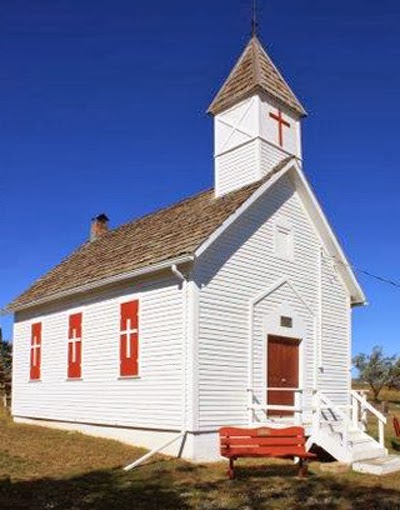
Little Dane Church
After over an hour at the Anderson Ranch we headed to the Little Dane Church to view the historic church and cemetery.  While no longer an active congregation, the church and its well-maintained cemetery are a tribute to the Scandinavian settlers along Dry Creek, south of St. Onge.

We then proceeded to the Minuteman Missile site K-05 as we drove towards St. Onge.  After explaining its significance during the Cold War, Vernon Davis talked about his experiences as a contractor in maintaining the sites. 

Next on the tour was a picnic lunch at the St. Onge City Park.  Thank goodness the park had a windbreak so we had a respite from the wind.  After showing historic pictures of early St. Onge and Vernon Davis talking about what we would be seeing we set out on a walking tour of the town to see what remains today.  


An historic building (1910) in St. Onge
Then we drove up to the Rodeo Grounds to see the tombstone of Jimmy Irons.  Headed back to St. Onge we looked at the abandoned school that had an enrollment at one time of 100 students, the last remaining church, the UCC church and then the city cemetery that has two entrances, one for the Catholics and one for the Protestants.  Vernon Davis had grown up in the area and added unique insights to the area history that is much appreciated. 

After this successful tour, we need to start thinking Spring and where we can go next?  

(Note:  Thanks to Sam Namminga, Mary Gallup-Livingston, and Norma Kraemer for sharing photos!  You'll find a wide array of photographs in our LCHS Gallery)

Sunday, April 28, 2013

Great weather…great tour…Thank You, Whitewood!

by Norma Kraemer

The Spring Tour of the Lawrence County Historical had 42 participants sign in for a day of perfect weather as we toured the ghost town of Crook City, SD and the survivor of 125 years Whitewood, SD.  The city of Whitewood were our hosts for the day and outdid themselves in teaching us about the history of their town. 

We started the day with the group driving to the site of Crook City.  Jerry Bryant did a great presentation on the location of the old town with a collection of old photographs he used to take us back in time when it was a bustling mining town. When the railroad chose Whitewood as its terminus, it was the death knell of Crook City. Mary Livingston, the Whitewood historian who made the arrangements for the rest of the day, met us at the Crook City location and then led us to Whitewood, pointing out the location of the old railroad bed that went between Whitewood and Deadwood. 

The next location to visit was the Senior Citizen Center in Whitewood, where a delicious lunch waited for us.  The group enjoyed the soup and sandwiches before going on the walking tour of Whitewood (photo above) that Mary led with the assistance of Whitewood Mayor Deb Schmidt. 

Whitewood is observing the 125th anniversary of the town's founding this year, and Mary Livingston has been researching its history. She distributed a great brochure that showed the historic buildings and their stories.  It included the Lane Hotel, the Jones Building, the Uhlig Store, theBonniwell Building, the Whitewood Banking Company Building, the Methodist Church, the Danish-American Creamery, the Whitewood School, and the United Presbyterian Church. At each location the story of Whitewood and its residents unfolded by the able storytellers.  

City Hall had a display of historic photos for all to read and enjoy and the Presbyterian Church windows, dating from about 1911 were enjoyed by all before we ended the wonderful tour with pie and coffee served in the fellowship hall.  

The people of Whitewood made it a pleasure to have our annual Spring Tour.  Thank you!

Editor's note:  Visit our Spring Tour Photo Gallery to get a glimpse of this great tour.

Sunday, January 20, 2013

Members get update on the Fassbender collection

Richard Carlson is the Fassbender administrator
Both the president and the administrator of the historic Fassbender Photoghraphic Collection visited with members of the Lawrence County Historical Society on Sunday (1/20/13) at the Homestake Adams Research and Cultural Center (HARCC) in Deadwood.

That's where a growing force of volunteers come three days every week to help sort through the massive collection of 800,000 historical images that were collected by the Fassbender Black Hills Studio operation over six decades. 

Administrator Richard Carlson and Fassbender Board President Jean Martin, both of Lead, showed a variety of the pictures, negatives, proofs, and equipment that are all a part of the collection.  Carlson outlined the intricate process being used to preserve, protect, and prepare the collection for sharing with the public.

Purchased in 2011 by the cities of Lead, Deadwood, and Spearfish for $300,000, the materials were stored temporarily in a south Spearfish building until they could later be moved to a climate-controlled vault inside the HARCC.

More than 40 people have volunteered to assist with this massive undertaking -- but it's a process that will take time.

"By my early calculation, if we continued at the pace we started at, it could take up to 16 years to complete the project," said administrator Carlson.

But he noted that they've learned how to more effectively complete the process and save some time -- but just how long it will take is still a question.

"We've got to go through the hundreds of boxes, which have lots of 5 by 7 envelopes containing negatives, proofs, and sometimes prints," said Carlson.  Most of those envelopes have names and numbers that were used by the Fassbenders for filing their photographs.

Volunteers take everything out of those old envelopes envelopes, which are considered to be contaminated, and then carefully place the contents into acid-free paper envelopes.  The names, numbers, and other descriptors are noted on the new envelopes and passed to Carlson, who is putting the information into a database system.

Fassbender President Jean Martin of Lead
shows a sampling of Fassbender "proofs"
"We're even photocopying the old envelopes, since they often have information noted on them that can later be of use," said Carlson.

He gave a demonstration of how materials will be digitally scanned for storage and then be made readily accessible via their computer database.  Eventually, the materials will be available on a web site.   Attendees to this meeting were treating to a PowerPoint slide show of Fassbender photos projected onto a screen before and during the program.  You'll find one of the Fassbender photos -- along with others from this quarterly society meeting -- in our LCHS 2013 Photo Gallery

Carlson noted that the Fassbender Photographic Collection web site today is pretty rudimentary, but there are plans to expand it soon so that volunteers and the public can keep up to date with activities related to the collection.

There's been a growing interest in the old photos.  Samples from the collection have been reproduced and exhibited at various location in Deadwood, Spearfish, and Lead.  

Earlier this month, Carlson spoke to the Spearfish Area Historical Society.  Also on the program were Spearfish writer Paul Higbee and Betty Fassbender Johnson.  Higbee gave some insight into the history of the Fassbenders, and Mrs. Johnson offered some first-hand insight into the family business that captured so much area history on film that future generations will be able to enjoy.

Society president Norma Kraemer observed that there may be some LCHS members who would like to volunteer for the Fassbender project, and after the meeting Carlson visited with several folks about their interests.

Kraemer also introduced members of the LCHS Board of Directors -- including its newest member, Cindy Solaas of Deadwood.  This meeting also featured another great luncheon served up by Dave Brueckner and his crew from Cheyenne Crossing.  

The society is planning its Spring Tour on Saturday, April 27th.  Participants will visit the historic James Anderson Ranch just south of Whitewood for a brief tour before proceeding into Whitewood where a variety of events hosted by Whitewood citizens.

Then in May, the society will conduct its next quarterly meeting.  Keep an eye on this web site and local newspapers for dates, times, and further details.


Monday, September 24, 2012

More than 100 persons participate in the Fall Tour

by Norma Kraemer
LCHS President


Forest Service archaeologist Marissa Karchut gave a 
wonderful presentation on the history and restoration 

of the Friendship Tower atop Mount Roosevelt.
The Greek goddess of the day, Hemera, smiled on the Lawrence County Historical Society's Fall Tour on Sunday, September 23.  People signed in for the car caravan with a total of 106 people participating in at least part of the tour.  While a car caravan of the size involved was akin to herding cats, everyone was extremely cooperative to make it work.  At our first stop 84 made it the half mile up the trail to the Friendship Tower.  After people had a chance to wander around and check things out, Marissa Karchut of the U.S. Forest Service gave a great presentation on the history of the tower to honor President Theodore Roosevelt.  After she was done,LCHS member Dr. David Wolff, who wrote a biography on Seth Bullock the instigator of the tower, added real depth the significance of the historic marker. 

After everyone hiked down to the parking lot we ate our lunches and then headed downhill to the site of Deadwood Dick's cabin. LCHS member Michael Runge, the Deadwood Archivist, gave a thorough history of the Pine Crest Campground and Deadwood Dick's cabin complete with visual props that worked in a rustic setting. 

The caravan headed out to the parking lot of the old Roo Ranch along Boulder Canyon, where Jerry Bryant discussed the short-lived Deadwood Harness Racing Track.  Then I talked about the first plane to fly at Deadwood in 1912, taking off from the same hay meadow as the racetrack and landing at the rodeo grounds in Deadwood.

Tour participants explore Barker's Cave, perched on
the side of Whitewood Canyon Creek.
The last parade of cars headed back toward Deadwood and turned right on Whitewood Creek Road.  Much of the road is an old railroad bed with several railroad bridges converted to automobile traffic.  Eventually, Jerry Bryant said it was time to park and explore on foot.  So members explored the railroad tunnel, Barker's Cave, and observed the Natural Bridge from near Barker's Cave across the narrow valley.  Heading back to town we could see the site of Montana City, the slag pile, and the location of wagons being lowered into the canyon before modern roads were constructed. 

A good time was had by all. One man signing in at the start reported that he had given up Sunday football to bring his family on the tour.  I suspect he didn't regret his decision to see the gorgeous fall leaves and scenery that graced the entire trip.

Now we need to plan where we are going for the Spring Tour!

Editor's Note:  Visit our LCHS Fall Tour Gallery to see more photos of the tour!

Saturday, August 25, 2012

President's Note: "...a snapshot of our culture"

by Norma Kraemer

The Lawrence County Historical Society has been preserving our local history since 1969 through the efforts of its members.  One of its most notable achievements was a history book compiled and printed in 1981 titled Some History of Lawrence County.  The book is out of print and can sometimes be found as a used book in local stores.  

However, thirty years have passed and much has happened in that intervening time.  Public history is thriving with the Adams Museum, High Plains Heritage Center, and the Days of 76 Museum to name a few of the local venues.  However, the members of the Lawrence County Historical Society need to realize that they all need to participate in some way to persevere our history before it is lost. While the activities of one of your family members might seem relevant to only your immediate family, they are all part of the larger history of our area and need to be saved.

Many years ago, my sister took me to visit the main cemetery in Atlanta, GA, when she was living there, for a Sunday afternoon.  While we knew no one there, it certainly gave me an education in the culture of the Civil War, the Victorian Era, and the way people saw death up through the 1960’s.  Locally, Mt. Moriah Cemetery gives a different snapshot of our culture.  The Atlanta cemetery’s overwhelming lesson for me was that women, while cherished by the number of stunning angels gracing their tombstones, were still without historic significance in the view of society.  Most Victorian tombstones with the angels were inscribed “Mother” but she had no name of her own.  Under the moniker of “Mother,” it might say that Susie and Johnnie were her children.
 
Lawrence County is dotted with small cemeteries, often in disrepair.  Past groups of members have cleaned up cemeteries and tried to keep them from becoming a victim of a mining project.  The future will be more of the same vigilance to keep this most basic of history preserved.  One cannot hope that surviving relatives of the departed can do this job because often, there is no one left in the family.  The larger community must assume that role.  Therefore, if you know of a cemetery that needs attention please let us know so efforts can be organized to preserve those memories. 

If cemeteries are not your priority, there are also other activities that will preserve our Lawrence County history.  Just bring your ideas forward to see if we can collectively keep our history from being lost.  

Thursday, June 21, 2012

Aviation pioneer Vern Kraemer dies at 95

Vern Kraemer (1917-2012)
We are sorry to report the death of Luverne "Vern" Kraemer.  He died yesterday (6/20/12) at the age of 95 in Rapid City.   

The husband of LCHS vice-president Norma Kraemer, Vern Kraemer was a South Dakota aviation pioneer.  Born in Parker, South Dakota, Kraemer spent his early years in Wood -- and later Nemo.  And while he was first trained as a blacksmith, it was aviation that captured his imagination and attention -- a fascination that lasted more than eight decades.

Kramer earned his pilot's license in 1940 at the Spearfish airport, where he later worked as a mechanic for another aviation pioneer, Clyde Ice.  Your can read much more about this remarkable man in this Vern Kraemer online obituary.

During World War II, Kraemer was a mechanic and pilot with the Civil Air Patrol's Coastal Patrol.  Sixty years ago, after working as a mechanic for Boeing Aircraft and later as a commercial pilot, mechanic and flight instructor, he built the first licensed home-built aircraft in South Dakota.  That American Triwing aircraft is now  exhibited in the terminal building at Rapid City Regional Airport.  That aircraft -- and Vern Kraemer -- were recently the subjects of considerable media coverage, including this story and video carried by the Rapid City Fox News affiliate, KEVN. 

Our thoughts and prayers are with Norma Kraemer and all of the Kraemer family during this difficult time.

Monday, June 4, 2012

Nemo Road area in the flood of '72

by Norma Kraemer

Luverne "Vern" Kraemer and his first wife Bertha survived the Flood of ’72 at their home at the Box K Ranch three miles south of Nemo, SD. Luverne took the pictures in black and white the morning after the flood on June 10, 1972. The water was starting to recede, but the damage was obvious. He traveled as far north as Este Creek and as far south as the Pennington/Meade County line to take these pictures. Washed out bridges blocked travel beyond these locations. For a month after the flood, he had to travel to HWY 385 using Merritt-Estes Road and then to Johnson Siding to get to his job at the Rapid City airport because Nemo Road was impassable to Rapid City. 

Este Creek flooding at Nemo Road - 10 June 1972
He reports that at the height of the storm on June 9, the lightening was so continuous that it was almost like daylight outside. It rained for six hours for a total of 15”. Box Elder Creek came out of its banks and spread across the valley floor reaching within 75 yards of his home. The home is approximately 180 yards from the creek. Steamboat Rock, a prominent landmark bordering the east of his ranch, and all the surrounding hills were covered with waterfalls. Rocks the size of Volkswagen Beetles were floating down Box Elder Creek. One resident of the Ox Yoke Ranch died by being swept down Box Elder Creek, being found later near Black Hawk, SD.
 
It took the Lawrence County Road Department several days to remove the rocks covering Nemo Road that came out of the canyon north of the ranch home. Vern had to hire a front-end loader to remove the large rocks that extended into the field. Since he has an airport runway down the valley, for years he would give me a bucket when we walked down the runway to pick up rocks and remove them from the possible path of the aircraft to prevent propeller damage.  This was more than ten years after the flood.   

For more photographs and information about the impact of the 1972 flood in Lawrence County, visit our Historical Marker Gallery.

Sunday, November 13, 2011

Cerney tells about Black Hills fire towers


It was 100 years ago that the first fire rustic lookout was built in the Black Hills atop Harney Peak, the highest point between the Rocky Mountains and the European Alps.  The structure was quite modest when compared to the stone lookouts later erected by the Civilian Conservation Corps in the 1930’s.  By mid-Twentieth Century, steel towers had replaced many of the old wooden structures.

Author Jan Cerney (left) with
LCHS president Jeannine Guern
South Dakota author Jan Cerney shared a few photos and lots of facts about fire towers with members of the Lawrence County Historical Society on Sunday (11/13/11)  at the organization’s annual meeting in Deadwood.  The dinner session was held at the Homestake Adams Research and Cultural Center and was catered by the Stage Stop Café at Cheyenne Crossing.

Cerney’s presentation was largely based on a book about Harney Peak and the Historic Fire Lookout Towers of the Black Hills National Forest that she co-authored with Roberta Sago of Black Hills State University.   Cerney lives on a ranch with her husband, Bob, in the South Dakota Bad Lands.  Both Cerney and Sago have authored several books published by Arcadia, a leading publisher of local histories across the United States.

“Before they even began to construct towers, horses were used to patrol the area, and they’d have to ride a distance to report any fires,” said Cerney.

 Early lookout towers were quite humble, including those that were created simply by driving spikes into a tall tree, allowing a lookout to climb to a high vantage point to scan the region.  That was the simple strategy employed by the Homestake Mine lookout that was used near Moskee.  They later added a platform to the top.

This fire tower at Cement Ridge near the Wyoming-South Dakota border is one
of only a few such facilities that remain in operation across the Black Hills.
 “Most of the old towers that were built later have become hiking destinations – some are gone and totally destroyed – but a few are still used,” she noted.  They include structures at Mount Coolidge, Bear Mountain, Cement Ridge, Elk Mountain, and at Warren Peak in Wyoming.

“The Lakota called Harney Peak the center of the world,” Cerney told the group.  “Lakota leader Black Elk, his son Ben, poet John Neihardt and his daughters Enid and Hilda made a pilgrimage to Harney Peak back in 1931.”

Stage Coach Cafe at Cheyenne Crossing provided
a superb lunch for the annual meeting of the LCHS.
The next year, Neihardt and Black Elk collaborated on the book Black Elk Speaks, which told the story of Black Elk, a Lakota medicine man.

Cerney showed a few of the more than 200 photographs included in her book.   Today, perhaps the most recognizable remaining watch tower is the stone structure perched more than 7,200 feet above the Black Hills on Harney Peak.  It typifies the solid structures that were the handiwork of the CCC, which started building the tower in April of 1938.  By that November, they had used some 7,000 stones, 500 bricks, and 15,000 hollow tiles.  It was completed in 1939.

 The November 13th meeting served as the Annual Meeting for the Lawrence County Historical Society.  New officers were introduced, including Jeannine Guern of Deadwood, president; Norma Kraemer of Deadwood, vice-president; Jacke Mitchell of Spearfish, treasurer; and Donna Watson of Deadwood, secretary.  Members were delight to see Jerry Bryant and his wife, Linda, at this meeting.  Bryant had stepped down from the presidency earlier this year due to health reason.

You can review more photographs and additional information about the November meeting in our Historical Marker Gallery.