Sunday, March 20, 2011

Plight of Terry Cemetery garners statewide interest

It's not a "done deal," but the historic Terry Cemetery appears to have dodged the bullet -- at least for the moment.  The 1.3 acre cemetery is within an expansion area that Wharf Resources hopes to mine for gold over the next few years. 

The South Dakota Board of Minerals and Environment last Thursday (3/17/11) voted to include the cemetery on a list of "Special, Exceptional, Critical or Unique Lands," effectively protecting the cemetery from disturbance by Wharf -- at least until the Board makes a final determination, and that decision may not come for several months.

The cemetery lies adjacent to State Highway 473 about three miles west of Lead on the way to the Terry Peak Lodge and Wharf Resources, but it is hidden from motorists by a wooded hill.

Wharf's plans have attracted considerable media attention, and a story written by veteran capitol reporter Bob Mercer has found ink across the state from Aberdeen and Mitchell to Pierre and Spearfish.

One of the more recent stories regarding the embattled cemetery appeared in the Pierre Capitol Journal last Friday (3/18/11), and you can read it here.  The story was headlined,  "Wharf Official says Terry Cemetery won't be mined."

Friday, March 11, 2011

Terry, South Dakota -- an early view

The following article was originally posted on Black Hills Journal, a web site dealing with both contemporary and historic aspects of the Black Hills region.

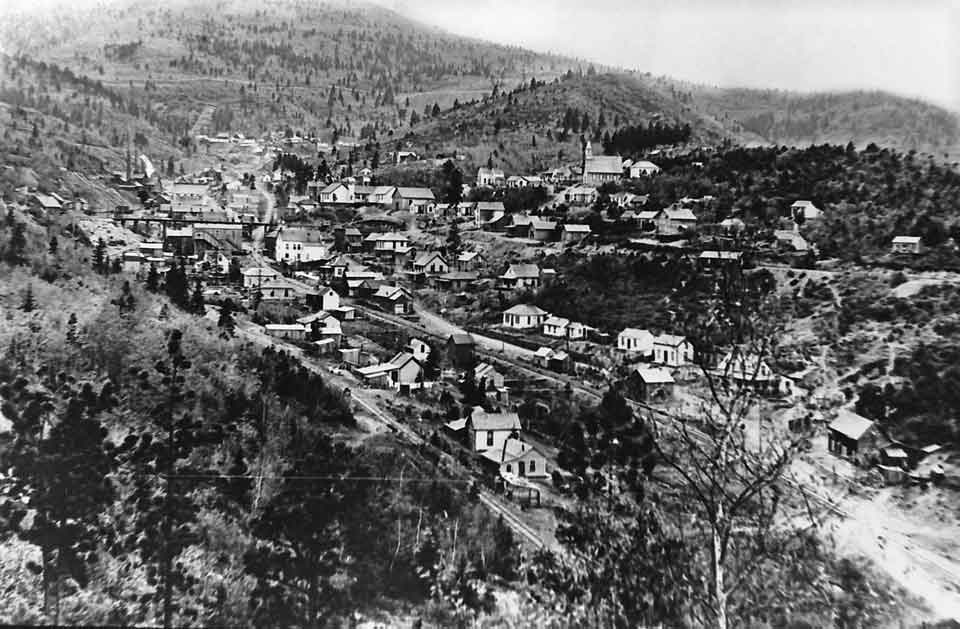
Undated view of Terry, South Dakota
With all the talk lately about the Terry Cemetery, which appears threatened by the planned expansion of gold mining near Terry Peak, we thought it might be of interest to post this photograph from the Lawrence County Historical Society archives.

The undated image -- probably taken at the dawn of the 20th century --  contains considerable detail. It is simply labeled "Terry." As can be seen, Terry was a formidable community, reliant upon the mining industry.  Some of the old  gold mining operations of an earlier era can be seen to the left in the photo.  That's probably the main operation of the Golden Reward Mining Company, which was easily the biggest business in Terry.

Terry was also a stop on the Burlington rail line.

Calamity Jane
In her book Roadside History of South Dakota, author Linda Hasselstrom wrote that  Terry was "home to a thousand people in 1893" and was one of the larger communities of Lawrence County.

If you click on the town photo above, you'll see a larger image, and you'll be able to more clearly see details of the old town, including the steeple of a church climbing skyward in the upper right quadrant.

By most accounts, Martha Jane Cannary -- better known as Calamity Jane -- died in 1903 at the Calloway  Hotel in Terry.  She was 51 years old.   Apparently Jane had requested that she be buried in Deadwood near Wild Bill Hickok, which is exactly what happened.

Some reckon that Hickok probably wouldn't have been too keen on that arrangement.  But for Calamity Jane, it was probably just as well.  Otherwise, she might have been buried in Terry, meaning that she could be uprooted anyway, if Wharf Resources chooses to go after the gold they believe is underneath the old Terry Cemetery.

Terry Cemetery
Disturbing the old cemetery at Terry.......now THAT is something many folks might consider a real calamity.

There are at least 120 souls who "went to their final resting place" at Terry Cemetery.  Although less than a couple of hundred yards away from Nevada Gulch Road (State Highway 473), the cemetery is hidden by a steep hill that runs adjacent to the busy road.  Workers on their way home from a day at Wharf Resources -- and skiers on their way to Terry Peak Lodge -- are likely oblivious to the existence of this historic little cemetery.

If you have information or photos about the old town of Terry that you'd like to contribute, please contact us at Black Hills Journal.

Wednesday, March 2, 2011

Something "fishy" in Spearfish?

Perhaps one of most overlooked historic sites in the beautiful Black Hills is nestled in a small canyon on the south side of Spearfish.

The D.C. Booth Historic National Fish Hatchery has been a city landmark for more than 110 years.  Created in 1896, the facility was a very successful fish production sites – one of the earliest in the west.

It started hatching fish in 1899 and remained true to its mission “to propagate, stock, and establish trout populations in the Black Hills of South Dakota and Wyoming." For many years, the old Spearfish National Fish Hatchery was headquarters for federal hatchery operations across much of the western United States.

Members of the Spearfish Area Historical Society learned all about the historic hatchery last night (2/1/11) at the March meeting of the society at the Spearfish Senior Citizen’s Center.

Despite bitter cold temperatures, a good crowd was on hand to hear hatchery curator  Randi Smith talk about the early days of the hatchery, as well as a few tips about preserving documents and photogrphs. 

Smith, shown at left, has been at the fish facility since 1992, but she nearly missed her career with the U.S. Fish and Wildlife Service.  She was a math major at the University of California-Davis when she became involved with the Antique Mechanics Club.  She ended up with a degree in history and a job as an interpretive historian in California State Parks.  That was followed by a 15-year-stint as curator at the Grant-Kohrs Ranch National Historic Site in Montana, which she says is “one of the most intact historic sites around.”  At D.C. Booth, she takes care of the museum, house, exhibits, research, and the museum collection and archives.

Smith traced the origin of U.S.Fish and Wildlife Service (USF&WS) back to 1871, when it was known as the U.S. Commission of Fish and Fisheries – or simply the “Fish Commission.”  Its first leader was Spencer Fullerton Baird, who also served simultaneously as Assistant Secretary of the Smithsonian Institution.

The first superintendent of the Spearfish hatchery was DeWitt Clinton (D.C.) Booth.  A large, two-story house was built for the Booth family in 1905, and it remains an inviting landmark on the hatchery grounds.

“By the late 1970’s, the Fish and Wildlife Service started putting the first museum collections at Spearfish,” said Smith.  “They recognized that they were accumulating historical items across the country – books, equipment, pictures, including a time capsule and other artifacts from the Hotchkiss National Fish Hatchery at Leadville, Colorado.”

In 1982, the Museum and Visitor Center opened, and the historical collections “really took off,” according to Smith.  The following year, the McNenny National Fish Hatchery just northwest of Spearfish was turned over to the South Dakota Department of Game, Fish and Parks.  While D.C. Booth Historic National Fish hatchery continued to rear fish that were hatched at McNenny, the Booth facility began to focus more on history.  It became a center for the collection of historic fisheries material from across the country, as well as the history of the U.S. Fish and Wildlife Service.

In addition to the many exhibits and historical items open to the public, Smith estimated that there are “about 175,000” items in storage that have come from across the region and the country.

“In the 1990’s, funding was received to construct an archive building, formally named the Collection Management Facility,” says Smith.   The collection includes materials from both public and private entities, including items from tribal governments.  While the original collection focused on hatchery items, it has been expanded to include anything related to fisheries.  Hatchery offices are also in the building.

Smith expressed the desire that many of the records and photographs at D.C. Booth be scanned and be made available to the public via the internet.

Touching a bit upon archival methods, Smith shared a number of hints that people can use to avoid damaging old photographs and documents.  Using acid-free paper and folders is important, as is shying away from products that contain adhesives – including rubber bands.

Pointing out that volunteers play a critical role in the operation of the historic hatchery, Smith took a moment to recognize several hatchery volunteers who were in the audience. You can learn more about the D. C. Booth Historic National Fish Hatchery by visiting this link at the U.S. Fish and Wildlife Service.

Monday, January 31, 2011

LCHS moves in to the HARCC....home at last!


New home for the Lawrence County Historical Society.
About 20 members of the Lawrence County Historical Society braved sub-zero temperatures today (1/31/11) for a bit of celebrating, as the society held its first-ever meeting in the new Homestake Adams Research and Cultural Center (HARCC)  building in Deadwood.

The group enjoyed cake, coffee and punch, followed by a tour of the HARCC, which is located at 150 Sherman Street.

LCHS president Jerry Bryant and Adams House and Museum Director Mary Kopco signed an agreement some weeks ago that gives the society a home in perpetuity – or  at least as long as Adams Museum & House, Inc. “remains the custodian” of HARCC.  While a room there is named the Lawrence County Historical Society Room, it will be used for a variety of other functions as well.  It will, however, serve as a site for LCHS meetings and research.

The HARCC staff have outfitted the LCHS Room with a marvelous conference table and several side chairs – furniture that came from the old Homestake Mining Company.  “We’ll have the table top smoothed up a bit for you,” said Mary Kopco, who indicated that they’ll also place a desk in the room for society use, augmenting an existing filing cabinet.

A spacious kitchen lies adjacent to the LCHS room. 

Kopco and Assistant Adams H&M Director Carolyn Weber led the group on a tour through both the upstairs and downstairs of the building.  For most members, it was the first time they’d been in the 17,000 square foot structure, which is designed to protect over 10,000 cubic feet of original documents in a climate-controlled and secure environment.

In 2005, Barrick Gold Corporation, successor to the Homestake Mining Company, donated the Homestake archival records to the Adams House.  The Adams board of directors realized that a new building was necessary to care for the materials – and offer public accessibility to the records.  The City of Deadwood bought the building to serve as the Homestake Adams Research and Cultural Center.

Ed Furois outside the Fassbender
vault during the LCHS tour.
The facility is the repository for extensive collections, including 126 years of maps and drawings of the Black Hills region, 45,000 historic photographs, slides and glass plate negatives; and a wide array of assay ledgers, diaries, scrapbooks, correspondence, blueprints, archaeological drawings, and much more.

The much-heralded Fassbender collection is also archived at the HARCC.  Comprised of more than 800,000 photographs, negatives, slides and motion picture footage from over nearly 100 years, the collection is now at the HARCC.  Josef Fassbender owned and operated Black Hills Studios for many decades.  His son, George, took over the business in 1958 and operated it until the late 1980s.  When George Fassbender died in 1998, he willed the collection to Ed Furois and Johnny Sumners of Spearfish. 

Lawrence County Historical Society helped facilitate preservation of the collection, which was purchased last year by the cities of Deadwood, Lead and Spearfish.  The publicly-owned collection was then moved to the HARCC, where it is secured in a climate-controlled vault.


LCHS treasurer Jacke Mitchell (right) presents a first
installment check to Adams H&M Director Mary Kopco
.
The HARCC hopes to provide easy access to a multitude of documents never before available to the public – and to host classes for secondary and post-secondary students on topics ranging from geology and astronomy to engineering and archaeology. 

We've placed a few HARCC tour photographs in the the LCHS Gallery.  There are some others there, too, that you might enjoy seeing.

While health issues prevented LCHS president Jerry Bryant from attending this special gathering, treasurer Jacke Mitchell took on the task of presenting Mary Kopco with the first of three $5,000 payments that the society will make over the next several months.

Another bit of good news for the society – South Dakota Secretary of State Jason Gant last week (1/24/11) signed the Articles of Incorporation documents for the Lawrence County Historical Society.  Revisions to society bylaws will be recommended to the LCHS board of directors when they meet at 3:00 p.m., on Friday, February 25th at the HARCC in Deadwood.

Wednesday, January 26, 2011

Remembering Cynthia Cleveland

Earlier this month, we posted a short video clip about a January 4th presentation given in Spearfish by Black Hills State University professor Laura Palmenero-Chilberg.  She surveyed the role of women’s clubs across the region and in the United States, but gave special emphasis to Spearfish and the northern Black Hills.

You’ll find a short summary of her “Early Spearfish Women’s Clubs” presentation on the Spearfish Area Historical Society web site.

Cynthia Cleveland
Shortly afterwards, LCHS President Jerry Bryant shared with us a newspaper clipping about another “women’s club” (of sorts!) that had major influence across the country – and a lady who played a key role in its development.

She was Cynthia Eloise Cleveland.  Reputed to be a distant cousin of president Grover Cleveland, Cynthia was born in New York in 1845.  The family later moved to Michigan and then to Nebraska.  By the time she was in her 30’s, Cynthia Cleveland had become actively involved with the Women’s Christian Temperance Union.

“After a brief four-year association with WCTU, Cynthia was offered an appointment by the national office as president of the Women’s Christian Temperance Union in the Dakotas,” writes Bryant.

Conversations with Jerry Bryant have revealed that Cynthia Cleveland was much more than a traditional pioneer woman.

Lecturer.  Temperance activist.  Author. Attorney.  And a favorite of the media, at least in her earlier years.  Of course, “the media” consisted mostly of newspaper folks, publishing papers in even the smallest of communities. 

Jerry Bryant
“In the short span of three days,” says Bryant about Cleveland’s 1881 arrival in Deadwood, she “swayed the Deadwood press into believing that her cause was not only just, but that her approach was logical and her views anything but fanatical.”  The Black Hills Daily Times published many of her articles and wrote that Cleveland was probably “the best single-handed talker who ever visited the Hills,” and that “it would do the old sinners of Deadwood a world of good to go and hear her at least once.”

Many Black Hills history buffs likely have never heard of Cynthia Cleveland, and those who have probably know little about her.  Her's is a story worth telling, and so a few years back Jerry Bryant researched and wrote, “Cynthia in the Dakotas,” which briefly chronicles her life.   

Cynthia Cleveland left a pretty big swath across Dakota Territory long before women were allowed even to vote – let alone serve as a member of the U.S. House of Representatives! You’ll find Jerry Bryant’s piece well worth the read.

Monday, January 10, 2011

Journal story confirms Wharf's position

Following up on an earlier story, Rapid City Journal reporter Kevin Woster has interviewed a few folks with different perspectives on the proposed expansion of gold mining near Terry Peak by Wharf Resources.  His article, Terry Cemetery move unlikely in near-term mining expansion, appeared yesterday (1/9/11) in the Rapid City Journal.

Rapid City Journal photo by Kristina Barker
Comments attributed to Wharf general manager Bill Shand reaffirmed what LCHS President Jerry Bryant was told by Shand earlier in the week:  moving the Terry Cemetery is "unlikely" within the next five years.

Woster also contacted Jolene Rantapaa, Secretary of the Terry Cemetery Association, whose comments give rise to another sticky question:  if Wharf doesn't move the cemetery, how can the dwindling membership and resources of the cemetery association continue to maintain the remote cemetery?  It's a question that looms for other old cemeteries in similar circumstance across Lawrence County and elsewhere.

Already chafing from having lost historic buildings and artifacts to the Wharf gold mining operations in the Terry and Trojan vicinities, the Lawrence County Historical Society board of directors met last week to explore ways that the society might assist with the preservation and maintenance of county cemeteries that are struggling.

The LCHS board will convene again in a few weeks to further examine -- among other things -- what steps it might be able to take regarding cemeteries.  The group is scheduled to meet at 3:00 p.m., Friday, February 25th, 2011, in the LCHS Room of the newly-completed Homestake Adams Research and Cultural Center (HARCC) in Deadwood.  

Monday, January 3, 2011

Bryant: "No Emergency" at Terry Cemetery

It appears that there is no imminent threat to the Terry Cemetery.

LCHS President Jerry Bryant spoke today (1/3/11) with Wharf Resources General Manager Bill Shand, who said he believes Wharf has no plans to do anything with the old cemetery for at least the next five years.

Wharf had filed documents with the South Dakota Department of Environment and Natural Resources on September 27th, indicating their intention to significantly expand their large scale gold mining operation near Terry Peak. (See our story of 12/25/10:  Terry cemetery area targeted.)  If approved, Wharf would expand its heap-leach gold mine operation by some 600 acres, including the old Golden Reward mining area.  The Terry Cemetery was included in their request for “Determination of Special, Exceptional, Critical or Unique Lands” submitted to DENR.

Shand told Bryant that, if and when Wharf decides to do anything with the cemetery – which “he doubts” – they will give “ample” notice to LCHS and other interested parties.

After talking with Shand and State Archaeologist Mike Fosha about the cemetery, Bryant said it would appear there is no emergency regarding possible disturbance of the cemetery. 

“But it never hurts to be prepared, and we’ll have our ducks in a row to combat it, whether it’s at Terry Cemetery or some other cemetery,” said Bryant. 

At least one individual plans to submit a nominating petition to include the cemetery on the preliminary list of “Special, Exceptional, Critical, or Unique Lands.  Jeannine Guern, who is active with both the Black Hills Pioneers and LCHS, plans to file her document with DENR before the January 11th deadline.

Cemetery preservation and maintenance is on the agenda for the LCHS Board of Directors when they meet tomorrow afternoon (1/4/11) in Deadwood.  The 4 o’clock meeting will take place at the Deadwood City Library.

The Board is also expected to discuss and take action regarding a contract with the Adams Museum and House, establishing the “terms and conditions” for use of the designated “LCHS Room” in the new Homestake Adams Research and Cultural Center.  LCHS earlier approved spending $15,000 to gain space “in perpetuity” in the nearly-completed HARCC, which is located at 150 Sherman Street in Deadwood. 

Construction on the structure is all but complete, and efforts are underway to outfit the facility.  A grand opening celebration is slated for Thursday, June 16th, 2011.

Saturday, December 25, 2010

Terry Cemetery area targeted


With gold prices nearly double what they were 10 years ago, Wharf Resources indicates they're moving forward with plans to expand their mining operations near Terry Peak -- and that could have implications for the Terry Cemetery.  

Although Wharf started its application process in September, it's been pretty much under the radar ever since.  That is, until a story by Kevin Woster emerged last week in the Rapid City Journal.  Woster wrote that the proposal "worries some nearby landowners and could force the relocation of more than 200 graves in the Terry Cemetery."

Above is a bit of history regarding the Terry Cemetery as depicted in the LCHS 1994 publication "Cemeteries and Graves in Lawrence County and Environs," edited by Irma Klock.

We suspect Wharf's proposal will gain additional attention in coming days as folks have an opportunity to comment on their plan.  If you wish to be heard, you should act by Tuesday, January 11th.  For a wealth of information -- and an opportunity to comment -- go to the South Dakota Department of Environment and Natural Resources web site.

As a sidebar, we are reminded of the appropriate steps taken some years back by Hershey Food Corporation when they discovered an old cemetery on land they were preparing to convert to a parking lot near their west plant in Hershey, Pennsylvania.  As it turns out, it was an old Hammacher family cemetery, ancestors of many Hamaker families now living in western South Dakota and western Nebraska.  Hershey stepped up to the plate and did the right thing by taking leadership in helping to preserve this historic cemetery.  We believe their actions serve as a model of corporate and civic responsibility.  
We hope Wharf Resources will display the same kind of leadership, but a public nudge in that direction might help.  

Friday, December 17, 2010

Con Stapleton: Deadwood's First Marshal

Submitted by Jerry Bryant
LCHS president

Born in 1848, Con Stapleton first set foot on American soil on 17 May 1872 in New York City. He had departed Ireland from Queenstown and made the journey berthed in the steerage section of the sailing steamer Manhattan.[1]

The Manhattan was a large two masted steamer that carried cargo and immigrants from Europe to the United States. On the voyage that brought Con Stapleton to the United States she was carrying more than 600 passengers, most of whom were traveling 3rd class.

No records have been found indicating what Stapleton was doing between his arrival in the States and his appearance in Deadwood in 1876. He first appears in the Black Hill Pioneer when he was elected town marshal as part of the initial quasi-legal city government, on 16 September 1876.[2] On 25 September 1876, he was in the news again when John Manning and others of the community advertised the formation of the Democrats of Lawrence County. Con Stapleton was noted to be one of the newly elected delegates to a proposed convention that would occur on September the 29th.[3]

Marshal Stapleton had his first real taste of duty when he received information and a photograph of a man who was wanted in Marion County, Iowa. The man, Horry Williams, had been convicted of murder. The judge asked him, after he was sentenced to twenty years imprisonment, if he had anything to say. His reply was short and to the point, “You may pass sentence on me, but I will never serve the term.” Later, as the sheriff was transporting him to the State Penitentiary, he overcame the sheriff and beat him to a “state of insensibility.” He then made good his escape. 

On the 24th of March, Stapleton solicited the assistance of Captain Hardwick and hit the trail in search of the desperado. They first traveled to Elk Creek, where they found that they were on the right trail, but a day and a half late. They slept overnight at Elk Creek and by 6:00 a.m. were back in hard pursuit. They rode to Battle River, and followed its course to Iron Creek. Here they encountered a cabin whose residents confirmed that the man they were looking for had been staying there and that he was presently out hunting. Stapleton and Hardwick decided to wait at the cabin for William’s return. At just about 5:00 p.m. the cabin door opened and they stood staring into the face of Horry Williams. Williams put his gun up at the request of his host, Dr. Woods and sat down to dinner. While eating and engaged in conversation, the Marshall and the Captain arrested him.  Williams was transported back to Deadwood without incident, where the authorities in Iowa were notified. Captain Hardwick then returned Williams back to Iowa and prison. [4]

The Shooting of David Lunt

A bunch of the boys were sitting around having drinks and talking at Al Chapman’s Saloon on the cold winter evening of the 14th of January 1877. Included in the group were Con Stapleton and David Lunt.  David was a very well liked man around town with a reputation of being a fair and genial man. The conversation was good, the saloon was warm, and drinks were cheap, when all of a sudden the saloon door burst open. A man named Tom Smith came in and drew his revolver. Smith then stated that if anyone moved he would shoot him. He approached the group that Lunt was with, leveled his revolver and continued shouting threats. At this point Con Stapleton grabbed Smith and attempted to disarm him, when the revolver went off. The ball narrowly missed Stapleton’s head, continued on and struck David Lunt in the forehead. Smith was arrested and brought to trial over the incident, but it appears that the only charge they could get him on at the time was discharging a firearm at a town marshal. At court, the fact that David Lunt was also shot during the fracas did not seem to enter into the verdict.  Tom Smith was taken off to Yankton for a real trial, which would also not consider the fact that Lunt was shot, and by March of the same year could be found walking the street of San Francisco

But what about Lunt? Well, of course, everyone thought that he was going to die, and real soon, but instead he got up and started to do the same things he had been doing before he was shot. He actually seemed like his old self, even though a bullet had pass completely through his skull, until the 22nd of March, when he began complaining of an extremely bad headache. Friends of his who owned the Centennial Hotel, Mr. and Mrs. Morgan, took him in and tried to nurse him back to health, but he kept sinking lower and that night about a quarter till 11, he died. Drs. Bevan and Babcock conducted a post-mortem the following morning. Their findings were that the bullet had passed through Lunt’s head, and in the process the bullet had carried an inch and half long bone fragment deep into his brain. The bone fragment caused a large abscess to form and the right hemisphere of the brain began to fill with fluid. Now the determination was made that Smith had committed murder and so Sheriff Seth Bullock sent a telegram to ascertain Smith’s where abouts and to issue a warrant for his arrest. He was arrested in San Francisco and sent back to Yankton for trial. The question that begs to be answered in this story is; how did David Lunt live for 67 days with a bullet hole through his skull and brain?[5] 

The Drawbacks of Not Having a Jail

As usual, most mining camp calamities happen at night and in a saloon, and such is the case of the shooting of Harry Varnes. Thirteen days after the tragedy of David Lunt’s shooting, Harry Varnes was shot and killed at Hanley’s Gayville saloon. The event started over what had been a friendly Saturday evening card game on the 27th of January, 1877. At the end of the game, one of the players, a Blacksmith named Hartgrove, was angered over the outcome. Hartgrove made several statements that enraged one of the other players, Harry Varnes. Varnes then stood up, raised his chair over his head as to hit Hartgrove with it. The chair never fell, as the saloon’s proprietor restrained Varnes. Simultaneously Hartgrove drew his revolver, but was prevented from firing it by several of Varnes’ friends. 

A short time elapsed and the crisis appeared to have ended, and then Hartgrove walked out of the saloon, but remained outside the door on the walk. Varnes called out to Hartgrove, asking him to come back in and have a drink, but Hartgrove declined. Between 10:00 and 11:00 Hartgrove kicked open the door to the saloon and stood outside. The previous argument was revived, and Hartgrove again drew his revolver and shot at Varnes through the door. With Varnes dying on the saloon floor, Hartgrove vanished into the night.

The next morning at approximately 6:00 a.m., Hartgrove woke up Marshal Stapleton at his room in Deadwood and explained what had happened the previous night, stating that he wished to give himself up. Stapleton replied, “all right; you know we have no jail here, so you must stop for the present where you are.” Hartgrove set down and began waiting. Soon he started complaining of the cold, so Stapleton told him to fire up the stove down stairs, and that he would be along when he was ready. Hartgrove warmed himself by the fire until about 9:00 a.m., when Stapleton came downstairs and joined him. At that time Hartgrove asked Stapleton if he could go consult with his lawyers, who had offices on the second floor of the same building. At this point, somewhere between the stove and the lawyer’s office, Hartgrove decided that he had inconvenienced Deadwood and it’s marshal long enough, and to quote the Pioneer; “That was the last seen of the perpetrator of this dread deed, and no doubt long ere this he is out of the reach of law or justice”[6]

On November the 7th 1877 Con Stapleton’s job as marshal was finished. The Office of City Marshal ceased to exist and it’s duties taken over by the Sheriff of Lawrence County.  Stapleton stayed in the Deadwood area only a short time during the year 1878. He was featured several times at the Gem Theater, once in a sparring match, another time in a wrestling match, and the last time as the referee for a wrestling match. After February of 1877 Stapleton drifted south to Denver, where it was reported that he had died in September of 1879. He would have been approximately 31 years old.
 ------------------------------ 
[1] . Records of immigrant entries to the City of New York, Ancestry.com
[2] . Black Hills Daily Pioneer, 16 Sept. 1876, pg4 col2
[3] . Black Hills Daily Pioneer, 25 Sept. 1876, pg1 col2
[4] . Black Hills Daily Pioneer, 31 march 1877, pg4 col2
[5] . Black Hills Daily Pioneer, 20 Jan 1877, pg4 col2
      Black Hills Daily Pioneer, 24 march 1877, pg4 col1
[6] . Black Hills Daily Pioneer, 3 Feb 1877, pg4 col3

Wolff tells story of gold and railroads in the Black Hills

The life and death of Wild Bill Hickok added a lot of flair to the history of Deadwood and the Black Hills.

Facts and embellishments regarding Wild Bill, Calamity Jane, and other 19th century characters helped give rise to a burgeoning tourism industry that continues into the 21st century.

But the growth and durability of old Deadwood links back directly to two things:  gold and railroads.

In his latest presentation to the Spearfish Area Historical Society (12/7/10), Black Hills State University professor David Wolff recounted the discovery of gold and the development of railroads in the Black Hills.
  
A pharmacist-turned-historian, Dr. Wolff is a Past President of the Lawrence County Historical Society and continues to serve on that board.  He is also a Vice-President of the South Dakota State Historical Society and is Chairman of the Adams Museum and House Board of Directors in Deadwood.

There were rumors of gold in the hills in the early 1800’s, Wolff told the audience.

“But who knows?” he asked somewhat rhetorically.

“If the Thoen Stone is to be believed, the Ezra Kind party was here in 1833 and 1834.  If Ezra and his buddies really got all the gold they could carry,  why wasn’t there a gold rush afterwards?  Well, nobody knew about it until Louis Thoen dug the stone up.  Of course, Thoen may have made the stone, but then that’s another story.”

Wolff proffered that both discovery and a rush are required, if such an event is to be considered a true gold rush.  While there were numerous reported “discoveries” earlier in the 1800’s, there certainly was no “rush” of prospectors to the region until 1874.  That’s when the Custer expedition – replete with 110 wagons and a thousand men – entered the western Black Hills near Buckhorn.  It was near present day Custer that year that Horatio Ross and William McKay reportedly found gold in July of that year.

Word spread rapidly, and the rush to the hills was on.  Wolff noted that early prospectors found some gold at Spring Creek, more near Sheridan, and along Rapid Creek.  But it wasn’t much, and for most it wasn’t enough to even pay a day’s wages. 

“If that’s all the gold that would’ve been found in the Black Hills, the gold rush would’ve died.  The men would have lost interest, packed up and left.  It would’ve been like the Big Horns in Wyoming, where there were repeated gold rushes, but they never found any real gold.

But that didn’t happen in the Black Hills, where several “paying locations” blossomed in Deadwood Gulch, along Deadwood Creek and Whitewood Creek.

By the spring of 1876, Fred and Moses Manuel found a large outcropping of ore that became the “Homestead Claim,” measuring 600 by about 1,500 feet.  It became a focal point for hardrock mining.  In the coming months, California entrepreneur George Hearst (at left) arrived on the scene and offered the Manuels and their partners $70,000 for their claims.

It was the beginning of the industrial mining that gave wealth to the region for more than a century.  Hearst and his partners developed the infrastructure necessary to process the ore, and many former prospectors went to work for the Homestake.  With the growth of the Homestake Mine, Lead became a true “company town,” while nearby Deadwood became a service center.

Even in those early days, railroads were an essential part of gold mining.  At first, it was mules and horses pulling ore out of the mines in wagons on rails.  By 1879, Homestake ordered a five-ton locomotive that had to be pulled by oxen from Bismarck, North Dakota to the Black Hills.  That engine – dubbed the J. B. Haggin – was a workhorse for the mine, which used rail to haul timbers needed for the mining operation.  Some 130 years later, the J. B. Haggin remains on display at the Adams Museum in Deadwood.

Wolff traced the expansion of rail service by the Fremont Elkhorn & Missouri Valley from Nebraska along the eastern edge of the hills, basically following the old Sidney to Deadwood stage route.  First to Buffalo Gap in 1885, on to Fairburn, Hermosa, and eventually Rapid City.   In 1887, the railroad started building again, creating excitement in places like Deadwood, Sturgis, and Crook City.  Instead, FE&MV built north 10 miles and created the town of Whitewood.  From 1887 to 1890, all rail business in the area came out of Whitewood.

Then came news that the Burlington line was building north out of Nebraska toward the coal field of Wyoming.  After creating their own company town in Edgemont, Burlington announced plans to build track to Deadwood, which was eager to see the local Black Hills & Fort Pierre line connect with main lines outside the hills.  Despite its name, said Wolff, the Black Hills and Fort Pierre Railroad ran from Lead to Sugar Loaf, Brownsville, then Nemo, and just to the edge of the Black Hills.  There was no service to Pierre.

“1890 was an exciting time in the Black Hills as the Elkhorn began building from Whitewood to Deadwood, and the Burlington started building up through the center of the Black Hills in a classic railroad race.”

The Fremont Elkhorn & Missouri Valley railroad, a subsidiary of the Chicago and North Western Railway, arrived first in Deadwood -- December of 1890.  But the Burlington wasn't far behind -- January 1891.  Both companies established depots in close proximity.  C&NW signage for the old FE&MV depot is still displayed on the side of the old depot building in Deadwood.  It is now a tourist information center.

Wolff quoted Sol Star, then Mayor of Deadwood, as saying that with the arrival of outside railroads, “Deadwood is finally a city of permanence.”

Wolff briefly recounted the role of Seth Bullock in helping the railroad develop Belle Fourche, much to the chagrin of nearby Minnesela residents, who had enlisted Bullock’s help to ensure that the line would pass through their community – which is no more.  More details about this event can be found in Wolff’s book Seth Bullock – Black Hills Lawman.

Tuesday, December 14, 2010

Not the New Christy Minstrels.....but WHO?

These folks took time out from Days of '76 festivities in 1930 Deadwood to pose for this photograph. Jerry Bryant was kind enough to share this photo, and we'd like to try to identify those pictured.   Drop us an e-mail if you can help.

Saturday, November 13, 2010

Pay Dirt - A book review by Jerry L. Bryant

 The story of how Uncle Torwal and Whitey were chawed off their Ranch by Grasshoppers and went up in the Black Hills to Sluice Gold for a spell.
Pay Dirt by Glen Rounds - 1938    Holiday House, New York

For those who would like a short taste of what life was like during the Automobile Gold Rush, the children’s book “Pay Dirt” is an absolute delight. The story told is of the Great Depression as seen through the eyes of a ten year old named Whitey. The book describes searching for gold and sluicing in 1931 in and around Hill City, South Dakota. While it was written for children, it contains a wealth of ideas and terms associated with placer mining and also hosts a visit to the Golden Eagle mine, where the mine supervisor, his Uncle’s friend, explains hardrock mining to Whitey. The following is a brief sample of the book’s narrative:

This is a drawing from inside the book.
The author did all of his own drawings.
“Whitey admired Uncle Torwal’s droopy red mustache more than a little bit. Somewhere he had heard that he could grow one like it by putting cream on his lip and letting the cat lick it off. But although nothing had come of the treatment so far, he was far from discouraged……Uncle Torwal wore his drawers outside of his shirt, cutting slits in the top for his suspender straps to run through before they fastened to his overalls. This left about an inch of the drawers showing all the way around between the pants and the shirt, and Whitey thought it a very elegant style indeed. He could hardly wait until he wore drawers like that so he could do the same.”

Several Dakota place names are mentioned throughout the book, and even as an adult reader, I found it difficult not to imagine myself delightfully along the same stream panning gold with Uncle Torwal and Whitey.

Author Glen Rounds was a South Dakota Native. He was born in a sod house near the Badlands in 1906. He grew up in South Dakota and on a horse ranch in Montana. He studied art at the Art Institute of Kansas City with Jackson Pollock. Rounds wrote or illustrated 150 books over a 60-year period. He died in North Carolina in 2002. In a brief computer search, I could only find four copies of this book in South Dakota Libraries, and all of them were at the State Library in Pierre. Of the many books by Rounds, "Pay Dirt" was his third book