Friday, October 7, 2011

Weavers battle Preston Cemetery vegetation


Jim and Verla Weaver visited the Preston Cemetery on Sunday, October 2, welcomed by a rather overwhelming overgrowth of vegetation.  They cut down 40 or 50 finger sized saplings, a couple of two-inch pines, and many weeds.

"There were many thistles, some poison ivy, and many other weeds," Jim said.

"In general the site looks very good. It was a good time to visit as the fall colors were beautiful and the temp was good for working.

As we were approached the cemetery, perhaps as close as 100 yard from the cemetery, we surprised a mountain lion in the the road. He quickly turned about face and bounded into the woods."

Verla snapped this photo shortly after they arrived at the cemetery.

Thursday, September 1, 2011

Black Hills Feature Film Company

More than a decade before the Academy of Motion Picture Arts & Sciences began staging Academy Award ceremonies in Hollywood, one of the earliest western films about Wild Bill Hickock was produced in…….Chadron, Nebraska?

Not that the movie would have won an Oscar. According to the Nebraska State Historical Society, it wasn’t even close to being an accurate depiction of Wild Bill, but it was an ambitious undertaking for a group of local folks in Chadron who produced the film.

Entitled Wild Bill and Calamity Jane in the Days of ’75 and ’76, the 1916 movie was said to have embraced several “state of the art” production techniques, including film masking and titles within the film. Most intriguing for us was the fact that local citizens created the Black Hills Feature Film Company and sold stock in an effort to bankroll the project. We don’t know how many shares they sold, but one “William Chalk” was the proud owner of Certificate No. 4, shown here.

Interestingly, the certificate is signed by Willis Schenck, Secretary, and A. L. Andrews, President, of the Black Hills Feature Film Company – and Schenck also performed in the film. According to the credits, he played the role of “Nettie’s father.”

But the real limelight of this film was focused on a young lady by the name of Freeda Hartzell Romine, who – according to the Centennial History of Chadron, Nebraska (1985) – was born in Nebraska but grew up in Deadwood, South Dakota. That’s where, so the story goes, she learned to become an expert rifle shot and honed her skills well enough to appear in the 1904 World’s Fair in St. Louis with Will Rogers. She would have been only about 12 or 13 years old. The photo here shows Freeda with fellow performers in Wild Bill and Calamity Jane in the Days of '75 and '76.

The young lass also toured with Buffalo Bill Cody’s Western Show for several years, according to an account in Dawes County - The First 100 Years, published in 1985. She and her railroader husband, Guy Romine, had a daughter, Catherine. Many years later, the Romine’s divorced. Freeda reportedly lived for several more years in Chadron, but also had a home in Indiana. We know nothing about her final days.

Other "locals" in the film included Freeda's mother, Mary Hartzell, who portrayed Calamity's mother, and A.L. Johnson, who was cast as Wild Bill. Barney Efting played the infamous Jack McCall, while Dick Iaeger was Calamity's brother. In researching this local drama troupe, we discovered that Iaeger was an uncle to Karen (Kindig) Schlais, who still lives in Chadron.

Alas, this film – and the film company – were also lost in obscurity. Fortunately, the movie was finally “re-discovered” some years ago and placed in the Nebraska archives in Lincoln. It was dusted off and featured a few years ago by Nebraska Educational Television in their Next Exit series.

Enjoy this glimpse of film magic that is nearly 100 years old.
~

Wednesday, July 27, 2011

Australian inquiry -- can anyone help?

We've received an inquiry from an Australian author named Anthony Hill.  It concerns an early-day Deadwood resident by the name of John G. Cowper.   You'll find the full text of Mr. Hill's communication in this LCHS Inquiry document.  Please contact him directly, if you're able to lend a hand to a friend from "Down Under."

Monday, May 23, 2011

Despite rain.....Historic Homes Tour a success!

More than 80 people joined the Lawrence County Historical Society for its first Historic Homes Tour yesterday (5/22/11) in historic Deadwood.

Despite relentless rains that had swollen creeks around the area, tour participants began aggregating at the Homestake Adams Archives and Cultural Center (HARCC) shortly after noon, eager to get started on the adventure.

“We were delighted with the turnout,” said event chairman Jeannine Guern. “It was a new experience for us, and we hope to build on this opportunity and create even better tours in the future.”

The Louie LeLonde home was one of five homes
included in the LCHS Historic Homes Tour.
Bad weather and reducing the number of homes on the tour from seven to five didn’t seem to dampen the spirits of participants.

“This was a wonderful experience – rich with history,” one young man told LCHS volunteers after the tour.

For the Lawrence County Historical Society (LCHS), the event netted more than $800.

The society is deeply grateful to the owners of the historic homes included in the tour. They not only allowed participants to come in to their homes – they enriched the experience by sharing information and stories about the historic structures.  You'll find additional photos and narrative information in our LCHS Gallery.

Our sincere thanks go to: Louie LaLonde, Raven Van Tassell, Lynn Namminga, Larry Kracht, and Dustin and Laura Floyd. Without their participation and support, the tour simply could not have succeeded.

The  Dustin & Laura Floyd home is in the midst
of significant restoration and improvement.
Bruce Oberlander of Dakota Graphics was great help with our posters and other print materials, while Mary Kopco and staff at the Homestake Adams Research and Cultural Center were unwavering in their support for this event.

Lots of LCHS volunteers worked long and hard to ensure the success of the tour. Among them: Donna Watson, Jeannine Guern, Lynn Namminga, Jacke Mitchell, Linda Bryant, Norma Kraemer, Judy Farris, Larry Miller, Marshall Raeburn, Mike Runge, as well as Sam and Linda Namminga.  Also, a tip of the hat to Deadwood Trolley driver Richard Marsolek, who did a superb job of shuttling people as needed between locations.  Of course, the assistance and support from the City of Deadwood, which provided the Trolley, was invaluable.

By the way, you'll find a nice set of interior photographs of the Lynn Namminga home in our Namminga Gallery

Many thanks to both First Gold and Four Aces casinos for donating free dinners to two lucky tour participants: Barbara Ayer of Nemo and Doug Kraft of Belle Fourche.  Congratulations Barbara and Doug!

Saturday, March 26, 2011

Hidden treasure: Terry school photo

Undated school photograph believed to be from Terry, South Dakota.
Over the past several days, members of the Lawrence County Historical Society have been completing an inventory of a couple of filing cabinets containing old society financial records, manuscripts, audio tapes, photographs, and sundry other materials.

Among the treats we came across was this undated school photograph.  On the back of the photo was written Terry school children and teachers.  Terry has been a subject of much discussion lately, so we thought you might be interested in this photo.

Even better, we're hopeful that someone may recognize the photo -- perhaps have a better copy of it.  Best of all, perhaps we could date and begin identifying some of the people in the photo.

Visit our LCHS Gallery for a higher resolution version of the above photograph, along with numerous other photos related to the history of Lawrence County.

Sunday, March 20, 2011

Plight of Terry Cemetery garners statewide interest

It's not a "done deal," but the historic Terry Cemetery appears to have dodged the bullet -- at least for the moment.  The 1.3 acre cemetery is within an expansion area that Wharf Resources hopes to mine for gold over the next few years. 

The South Dakota Board of Minerals and Environment last Thursday (3/17/11) voted to include the cemetery on a list of "Special, Exceptional, Critical or Unique Lands," effectively protecting the cemetery from disturbance by Wharf -- at least until the Board makes a final determination, and that decision may not come for several months.

The cemetery lies adjacent to State Highway 473 about three miles west of Lead on the way to the Terry Peak Lodge and Wharf Resources, but it is hidden from motorists by a wooded hill.

Wharf's plans have attracted considerable media attention, and a story written by veteran capitol reporter Bob Mercer has found ink across the state from Aberdeen and Mitchell to Pierre and Spearfish.

One of the more recent stories regarding the embattled cemetery appeared in the Pierre Capitol Journal last Friday (3/18/11), and you can read it here.  The story was headlined,  "Wharf Official says Terry Cemetery won't be mined."

Friday, March 11, 2011

Terry, South Dakota -- an early view

The following article was originally posted on Black Hills Journal, a web site dealing with both contemporary and historic aspects of the Black Hills region.

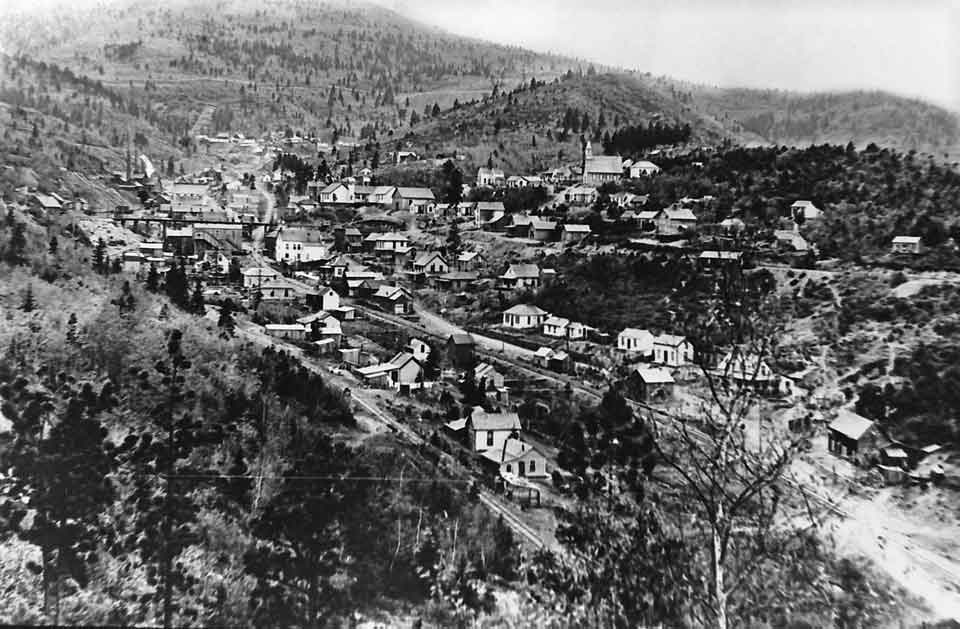
Undated view of Terry, South Dakota
With all the talk lately about the Terry Cemetery, which appears threatened by the planned expansion of gold mining near Terry Peak, we thought it might be of interest to post this photograph from the Lawrence County Historical Society archives.

The undated image -- probably taken at the dawn of the 20th century --  contains considerable detail. It is simply labeled "Terry." As can be seen, Terry was a formidable community, reliant upon the mining industry.  Some of the old  gold mining operations of an earlier era can be seen to the left in the photo.  That's probably the main operation of the Golden Reward Mining Company, which was easily the biggest business in Terry.

Terry was also a stop on the Burlington rail line.

Calamity Jane
In her book Roadside History of South Dakota, author Linda Hasselstrom wrote that  Terry was "home to a thousand people in 1893" and was one of the larger communities of Lawrence County.

If you click on the town photo above, you'll see a larger image, and you'll be able to more clearly see details of the old town, including the steeple of a church climbing skyward in the upper right quadrant.

By most accounts, Martha Jane Cannary -- better known as Calamity Jane -- died in 1903 at the Calloway  Hotel in Terry.  She was 51 years old.   Apparently Jane had requested that she be buried in Deadwood near Wild Bill Hickok, which is exactly what happened.

Some reckon that Hickok probably wouldn't have been too keen on that arrangement.  But for Calamity Jane, it was probably just as well.  Otherwise, she might have been buried in Terry, meaning that she could be uprooted anyway, if Wharf Resources chooses to go after the gold they believe is underneath the old Terry Cemetery.

Terry Cemetery
Disturbing the old cemetery at Terry.......now THAT is something many folks might consider a real calamity.

There are at least 120 souls who "went to their final resting place" at Terry Cemetery.  Although less than a couple of hundred yards away from Nevada Gulch Road (State Highway 473), the cemetery is hidden by a steep hill that runs adjacent to the busy road.  Workers on their way home from a day at Wharf Resources -- and skiers on their way to Terry Peak Lodge -- are likely oblivious to the existence of this historic little cemetery.

If you have information or photos about the old town of Terry that you'd like to contribute, please contact us at Black Hills Journal.

Wednesday, March 2, 2011

Something "fishy" in Spearfish?

Perhaps one of most overlooked historic sites in the beautiful Black Hills is nestled in a small canyon on the south side of Spearfish.

The D.C. Booth Historic National Fish Hatchery has been a city landmark for more than 110 years.  Created in 1896, the facility was a very successful fish production sites – one of the earliest in the west.

It started hatching fish in 1899 and remained true to its mission “to propagate, stock, and establish trout populations in the Black Hills of South Dakota and Wyoming." For many years, the old Spearfish National Fish Hatchery was headquarters for federal hatchery operations across much of the western United States.

Members of the Spearfish Area Historical Society learned all about the historic hatchery last night (2/1/11) at the March meeting of the society at the Spearfish Senior Citizen’s Center.

Despite bitter cold temperatures, a good crowd was on hand to hear hatchery curator  Randi Smith talk about the early days of the hatchery, as well as a few tips about preserving documents and photogrphs. 

Smith, shown at left, has been at the fish facility since 1992, but she nearly missed her career with the U.S. Fish and Wildlife Service.  She was a math major at the University of California-Davis when she became involved with the Antique Mechanics Club.  She ended up with a degree in history and a job as an interpretive historian in California State Parks.  That was followed by a 15-year-stint as curator at the Grant-Kohrs Ranch National Historic Site in Montana, which she says is “one of the most intact historic sites around.”  At D.C. Booth, she takes care of the museum, house, exhibits, research, and the museum collection and archives.

Smith traced the origin of U.S.Fish and Wildlife Service (USF&WS) back to 1871, when it was known as the U.S. Commission of Fish and Fisheries – or simply the “Fish Commission.”  Its first leader was Spencer Fullerton Baird, who also served simultaneously as Assistant Secretary of the Smithsonian Institution.

The first superintendent of the Spearfish hatchery was DeWitt Clinton (D.C.) Booth.  A large, two-story house was built for the Booth family in 1905, and it remains an inviting landmark on the hatchery grounds.

“By the late 1970’s, the Fish and Wildlife Service started putting the first museum collections at Spearfish,” said Smith.  “They recognized that they were accumulating historical items across the country – books, equipment, pictures, including a time capsule and other artifacts from the Hotchkiss National Fish Hatchery at Leadville, Colorado.”

In 1982, the Museum and Visitor Center opened, and the historical collections “really took off,” according to Smith.  The following year, the McNenny National Fish Hatchery just northwest of Spearfish was turned over to the South Dakota Department of Game, Fish and Parks.  While D.C. Booth Historic National Fish hatchery continued to rear fish that were hatched at McNenny, the Booth facility began to focus more on history.  It became a center for the collection of historic fisheries material from across the country, as well as the history of the U.S. Fish and Wildlife Service.

In addition to the many exhibits and historical items open to the public, Smith estimated that there are “about 175,000” items in storage that have come from across the region and the country.

“In the 1990’s, funding was received to construct an archive building, formally named the Collection Management Facility,” says Smith.   The collection includes materials from both public and private entities, including items from tribal governments.  While the original collection focused on hatchery items, it has been expanded to include anything related to fisheries.  Hatchery offices are also in the building.

Smith expressed the desire that many of the records and photographs at D.C. Booth be scanned and be made available to the public via the internet.

Touching a bit upon archival methods, Smith shared a number of hints that people can use to avoid damaging old photographs and documents.  Using acid-free paper and folders is important, as is shying away from products that contain adhesives – including rubber bands.

Pointing out that volunteers play a critical role in the operation of the historic hatchery, Smith took a moment to recognize several hatchery volunteers who were in the audience. You can learn more about the D. C. Booth Historic National Fish Hatchery by visiting this link at the U.S. Fish and Wildlife Service.

Monday, January 31, 2011

LCHS moves in to the HARCC....home at last!


New home for the Lawrence County Historical Society.
About 20 members of the Lawrence County Historical Society braved sub-zero temperatures today (1/31/11) for a bit of celebrating, as the society held its first-ever meeting in the new Homestake Adams Research and Cultural Center (HARCC)  building in Deadwood.

The group enjoyed cake, coffee and punch, followed by a tour of the HARCC, which is located at 150 Sherman Street.

LCHS president Jerry Bryant and Adams House and Museum Director Mary Kopco signed an agreement some weeks ago that gives the society a home in perpetuity – or  at least as long as Adams Museum & House, Inc. “remains the custodian” of HARCC.  While a room there is named the Lawrence County Historical Society Room, it will be used for a variety of other functions as well.  It will, however, serve as a site for LCHS meetings and research.

The HARCC staff have outfitted the LCHS Room with a marvelous conference table and several side chairs – furniture that came from the old Homestake Mining Company.  “We’ll have the table top smoothed up a bit for you,” said Mary Kopco, who indicated that they’ll also place a desk in the room for society use, augmenting an existing filing cabinet.

A spacious kitchen lies adjacent to the LCHS room. 

Kopco and Assistant Adams H&M Director Carolyn Weber led the group on a tour through both the upstairs and downstairs of the building.  For most members, it was the first time they’d been in the 17,000 square foot structure, which is designed to protect over 10,000 cubic feet of original documents in a climate-controlled and secure environment.

In 2005, Barrick Gold Corporation, successor to the Homestake Mining Company, donated the Homestake archival records to the Adams House.  The Adams board of directors realized that a new building was necessary to care for the materials – and offer public accessibility to the records.  The City of Deadwood bought the building to serve as the Homestake Adams Research and Cultural Center.

Ed Furois outside the Fassbender
vault during the LCHS tour.
The facility is the repository for extensive collections, including 126 years of maps and drawings of the Black Hills region, 45,000 historic photographs, slides and glass plate negatives; and a wide array of assay ledgers, diaries, scrapbooks, correspondence, blueprints, archaeological drawings, and much more.

The much-heralded Fassbender collection is also archived at the HARCC.  Comprised of more than 800,000 photographs, negatives, slides and motion picture footage from over nearly 100 years, the collection is now at the HARCC.  Josef Fassbender owned and operated Black Hills Studios for many decades.  His son, George, took over the business in 1958 and operated it until the late 1980s.  When George Fassbender died in 1998, he willed the collection to Ed Furois and Johnny Sumners of Spearfish. 

Lawrence County Historical Society helped facilitate preservation of the collection, which was purchased last year by the cities of Deadwood, Lead and Spearfish.  The publicly-owned collection was then moved to the HARCC, where it is secured in a climate-controlled vault.


LCHS treasurer Jacke Mitchell (right) presents a first
installment check to Adams H&M Director Mary Kopco
.
The HARCC hopes to provide easy access to a multitude of documents never before available to the public – and to host classes for secondary and post-secondary students on topics ranging from geology and astronomy to engineering and archaeology. 

We've placed a few HARCC tour photographs in the the LCHS Gallery.  There are some others there, too, that you might enjoy seeing.

While health issues prevented LCHS president Jerry Bryant from attending this special gathering, treasurer Jacke Mitchell took on the task of presenting Mary Kopco with the first of three $5,000 payments that the society will make over the next several months.

Another bit of good news for the society – South Dakota Secretary of State Jason Gant last week (1/24/11) signed the Articles of Incorporation documents for the Lawrence County Historical Society.  Revisions to society bylaws will be recommended to the LCHS board of directors when they meet at 3:00 p.m., on Friday, February 25th at the HARCC in Deadwood.

Wednesday, January 26, 2011

Remembering Cynthia Cleveland

Earlier this month, we posted a short video clip about a January 4th presentation given in Spearfish by Black Hills State University professor Laura Palmenero-Chilberg.  She surveyed the role of women’s clubs across the region and in the United States, but gave special emphasis to Spearfish and the northern Black Hills.

You’ll find a short summary of her “Early Spearfish Women’s Clubs” presentation on the Spearfish Area Historical Society web site.

Cynthia Cleveland
Shortly afterwards, LCHS President Jerry Bryant shared with us a newspaper clipping about another “women’s club” (of sorts!) that had major influence across the country – and a lady who played a key role in its development.

She was Cynthia Eloise Cleveland.  Reputed to be a distant cousin of president Grover Cleveland, Cynthia was born in New York in 1845.  The family later moved to Michigan and then to Nebraska.  By the time she was in her 30’s, Cynthia Cleveland had become actively involved with the Women’s Christian Temperance Union.

“After a brief four-year association with WCTU, Cynthia was offered an appointment by the national office as president of the Women’s Christian Temperance Union in the Dakotas,” writes Bryant.

Conversations with Jerry Bryant have revealed that Cynthia Cleveland was much more than a traditional pioneer woman.

Lecturer.  Temperance activist.  Author. Attorney.  And a favorite of the media, at least in her earlier years.  Of course, “the media” consisted mostly of newspaper folks, publishing papers in even the smallest of communities. 

Jerry Bryant
“In the short span of three days,” says Bryant about Cleveland’s 1881 arrival in Deadwood, she “swayed the Deadwood press into believing that her cause was not only just, but that her approach was logical and her views anything but fanatical.”  The Black Hills Daily Times published many of her articles and wrote that Cleveland was probably “the best single-handed talker who ever visited the Hills,” and that “it would do the old sinners of Deadwood a world of good to go and hear her at least once.”

Many Black Hills history buffs likely have never heard of Cynthia Cleveland, and those who have probably know little about her.  Her's is a story worth telling, and so a few years back Jerry Bryant researched and wrote, “Cynthia in the Dakotas,” which briefly chronicles her life.   

Cynthia Cleveland left a pretty big swath across Dakota Territory long before women were allowed even to vote – let alone serve as a member of the U.S. House of Representatives! You’ll find Jerry Bryant’s piece well worth the read.

Monday, January 10, 2011

Journal story confirms Wharf's position

Following up on an earlier story, Rapid City Journal reporter Kevin Woster has interviewed a few folks with different perspectives on the proposed expansion of gold mining near Terry Peak by Wharf Resources.  His article, Terry Cemetery move unlikely in near-term mining expansion, appeared yesterday (1/9/11) in the Rapid City Journal.

Rapid City Journal photo by Kristina Barker
Comments attributed to Wharf general manager Bill Shand reaffirmed what LCHS President Jerry Bryant was told by Shand earlier in the week:  moving the Terry Cemetery is "unlikely" within the next five years.

Woster also contacted Jolene Rantapaa, Secretary of the Terry Cemetery Association, whose comments give rise to another sticky question:  if Wharf doesn't move the cemetery, how can the dwindling membership and resources of the cemetery association continue to maintain the remote cemetery?  It's a question that looms for other old cemeteries in similar circumstance across Lawrence County and elsewhere.

Already chafing from having lost historic buildings and artifacts to the Wharf gold mining operations in the Terry and Trojan vicinities, the Lawrence County Historical Society board of directors met last week to explore ways that the society might assist with the preservation and maintenance of county cemeteries that are struggling.

The LCHS board will convene again in a few weeks to further examine -- among other things -- what steps it might be able to take regarding cemeteries.  The group is scheduled to meet at 3:00 p.m., Friday, February 25th, 2011, in the LCHS Room of the newly-completed Homestake Adams Research and Cultural Center (HARCC) in Deadwood.  

Monday, January 3, 2011

Bryant: "No Emergency" at Terry Cemetery

It appears that there is no imminent threat to the Terry Cemetery.

LCHS President Jerry Bryant spoke today (1/3/11) with Wharf Resources General Manager Bill Shand, who said he believes Wharf has no plans to do anything with the old cemetery for at least the next five years.

Wharf had filed documents with the South Dakota Department of Environment and Natural Resources on September 27th, indicating their intention to significantly expand their large scale gold mining operation near Terry Peak. (See our story of 12/25/10:  Terry cemetery area targeted.)  If approved, Wharf would expand its heap-leach gold mine operation by some 600 acres, including the old Golden Reward mining area.  The Terry Cemetery was included in their request for “Determination of Special, Exceptional, Critical or Unique Lands” submitted to DENR.

Shand told Bryant that, if and when Wharf decides to do anything with the cemetery – which “he doubts” – they will give “ample” notice to LCHS and other interested parties.

After talking with Shand and State Archaeologist Mike Fosha about the cemetery, Bryant said it would appear there is no emergency regarding possible disturbance of the cemetery. 

“But it never hurts to be prepared, and we’ll have our ducks in a row to combat it, whether it’s at Terry Cemetery or some other cemetery,” said Bryant. 

At least one individual plans to submit a nominating petition to include the cemetery on the preliminary list of “Special, Exceptional, Critical, or Unique Lands.  Jeannine Guern, who is active with both the Black Hills Pioneers and LCHS, plans to file her document with DENR before the January 11th deadline.

Cemetery preservation and maintenance is on the agenda for the LCHS Board of Directors when they meet tomorrow afternoon (1/4/11) in Deadwood.  The 4 o’clock meeting will take place at the Deadwood City Library.

The Board is also expected to discuss and take action regarding a contract with the Adams Museum and House, establishing the “terms and conditions” for use of the designated “LCHS Room” in the new Homestake Adams Research and Cultural Center.  LCHS earlier approved spending $15,000 to gain space “in perpetuity” in the nearly-completed HARCC, which is located at 150 Sherman Street in Deadwood. 

Construction on the structure is all but complete, and efforts are underway to outfit the facility.  A grand opening celebration is slated for Thursday, June 16th, 2011.