Monday, November 11, 2013

An update: Ice Skating in old Central City


It may not have drawn the crowds that fill the ice rink at  Rockefeller Center in New York City, but the American Legion Ice Skating Rink in Central City, South Dakota was once a popular place!  That's the big building in the center of this photograph. (Thanks to the Homestake Adams Research and Cultural Center [HARCC] in Deadwood) 

We're not quite sure exactly when the Homestake Mine closed Cyanide Sand Plant #2, between Deadwood and Lead (probably in the mid 1930s) but we've talked to many folks who remember visiting the spacious facility after it became home to a popular ice skating rink.

Documents at the Homestake Adams Research and Cultural Center (HARCC) in Deadwood reveal that the rink measured 60 feet by 360 feet.  According to information contained in the August 1963 edition of Sharp Bits, published by Homestake Mine, the rink was operated for many years by a local American Legion post.  What do you remember about this rink?  Drop us an e-Mail!   And you can take a closer look at the structure in our LCHS Photo Gallery.

Editor's Note:    In November 2013, a kind reader e-mailed us and provided more information about the rink.  She noted that it was "…naturally 'cooled' by the outdoor temp, and the snow would blow in on wintry days, but who really cared?  It remained open each season from the time it was cold enough for the ice to be laid, and sprayed to 'even out' the surface until the outdoor temps became too warm.  Huge hoses were used to lay down each layer of ice, and Mother Nature would take over each night.  Cecil Stoner operated the rink for several years, and then Tom Thoresen took over management for many years thereafter.  Skating was from 1:00-4:00 each Sunday; 7:00-9:00 on Wednesday and Friday nights, and two sessions on Saturdays (1:00-4:00 and 7:00 to 9:00)."

Sunday, October 13, 2013

"Aunt Lou" visits LCHS Fall Meeting in Deadwood

Joyce Jefferson at left portrays "Aunt Lou" Marchbanks, shown in old photo at right.
Despite power outages and other lingering aspects of the devastating blizzard last weekend, the Fall Meeting of the Lawrence County Historical Society proceeded as scheduled Sunday afternoon (10/13/13) at the Homestake Adams Research Center in Deadwood.

Humanities Scholar Joyce Jefferson provided the program -- a wonderful presentation featuring Jefferson slipping in to the role of Lucretia "Aunt Lou" Marchbanks, a most remarkable resident of early day Deadwood.

Sponsored by the South Dakota Humanities Council, the program followed a great buffet luncheon provided by Dave Bruckner and the good folks at the Cheyenne Crossing Stage Stop Cafe.

Jefferson's Chautauqua-style program was entitled "Who is Aunt Lou? We'll Tell You Who She Is," and featured Jefferson in costume as "Aunt Lou" Marchbanks.  Born a slave, "Aunt Lou" was -- according to a story in the March 27, 1890, edition of the Black Hills Daily Times, "…a most remarkable woman for the opportunities in life which were hers."

"A slave nurse during the war of the rebellion, but left the south immediately after the war.  She could neither read nor write, but had a most remarkable memory, and her reading of human nature and human character on first sight was unerring."

"Aunt Lou" shared stories about her youth and then as a housekeeper for officials of the Father De Smet Mining Company in Deadwood after arriving in the Black Hills in 1876.  She was 44 at the time.

Ms. Jefferson gave a fine performance, mingling some delightful musical ditties with some heartwarming stories about this remarkable woman who graced the mining districts in the northern Black Hills for so many years.    Jefferson also distributed copies of her Lucretia Marchbanks Gazetteer, which was published for the 2013 West River History Conference in Rapid City.  Replete with photographs, the publication contains a wonderful collection of news stories and anecdotes from the Black Hills Daily Times dating from 1877 into the early 1900's.

Since arriving at Ellsworth Air Force Base some years ago from Hawaii with her Air Force husband, Earl, and their son, Joyce Jefferson has found pleasure in working as an independent scholar and participating in the South Dakota Humanities Council's speakers bureau.  Her appearance at the HARCC was sponsored by both LCHS and the South Dakota Humanities Council, with support from a National Endowment for the Humanities grant.

Enjoy a few candid photographs from the "Aunt Lou" presentation, along with photos from earlier programs, in our LCHS Gallery.

Tuesday, October 1, 2013

Winds don't deter history buffs on LCHS Fall Tour


By Norma Kraemer, LCHS President

The fall Lawrence County Historical Society had a great tour on Saturday, September 28.  The weather was bright and sunny, although high winds followed us on our route.  About 25 people drove to the various locations that started with the Anderson Ranch near Whitewood. 

Whitewood native Elaine Albrandt (left) poses with Hank Frawley (right) in front of her painting of the James Anderson Ranch, drawn from a circa 1890 photo.
We were blessed with Hank Frawley being our host and guide to his great grandparents’ ranch. He has spent the last few decades trying to restore the historic buildings that made up a very successful dairy farm before the turn of the 20th Century.  Most of the restoration is completed, which was aided by Deadwood Historic Preservation grants. 

Touring historic Anderson Ranch near Whitewood
The Anderson Ranch had beautiful stone construction that needed major renovation.  Hank found it better to gut the structures, repair the exterior walls, and redo the interiors.  He talked of the challenges of finding historically accurate materials to do the job right.  He also showed us some of the other artifacts found during restoration and talked of how the location of the ranch has probably been a popular place for human habitation for thousands of years, based on the Indian artifacts found.  Because of the spring that supplies water year round at about 40°F, it made the dairy possible before there was electricity. 

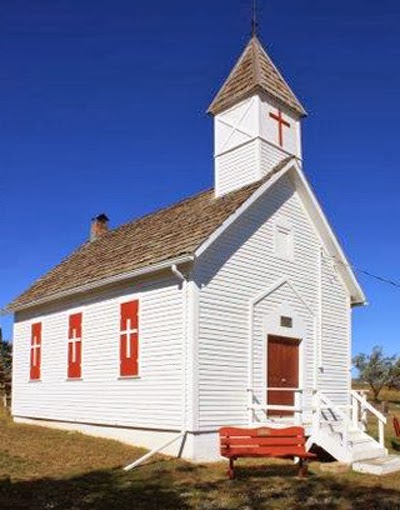
Little Dane Church
After over an hour at the Anderson Ranch we headed to the Little Dane Church to view the historic church and cemetery.  While no longer an active congregation, the church and its well-maintained cemetery are a tribute to the Scandinavian settlers along Dry Creek, south of St. Onge.

We then proceeded to the Minuteman Missile site K-05 as we drove towards St. Onge.  After explaining its significance during the Cold War, Vernon Davis talked about his experiences as a contractor in maintaining the sites. 

Next on the tour was a picnic lunch at the St. Onge City Park.  Thank goodness the park had a windbreak so we had a respite from the wind.  After showing historic pictures of early St. Onge and Vernon Davis talking about what we would be seeing we set out on a walking tour of the town to see what remains today.  


An historic building (1910) in St. Onge
Then we drove up to the Rodeo Grounds to see the tombstone of Jimmy Irons.  Headed back to St. Onge we looked at the abandoned school that had an enrollment at one time of 100 students, the last remaining church, the UCC church and then the city cemetery that has two entrances, one for the Catholics and one for the Protestants.  Vernon Davis had grown up in the area and added unique insights to the area history that is much appreciated. 

After this successful tour, we need to start thinking Spring and where we can go next?  

(Note:  Thanks to Sam Namminga, Mary Gallup-Livingston, and Norma Kraemer for sharing photos!  You'll find a wide array of photographs in our LCHS Gallery)

Wednesday, July 24, 2013

Another Toomey property bites the dust…

by Larry Miller 

We were surprised and a bit disappointed to just learn that we've lost yet another bit of Black Hills history.

Actually, the demise of Toomey's Mill in Newcastle, Wyoming occurred last year, and its passing has been lamented by more than just a few folks who either worked there, did business there, or in recent years enjoyed a meal there.   My wife and I fit into the last category.

Since retiring to the Hills more than eight years ago, we've tried to visit as much of the region as possible.  In fact, we nearly entered into a contract to buy a home on "Whoop-Up" Road near Newcastle in retirement -- but opted for Spearfish instead.

Nonetheless, we've passed through Newcastle numerous times, going and coming from family visits in Colorado.  Usually, it's simply to gas up and move on -- seems we're always in a hurry!

Seems it was Mother's Day in 2010 when we last stopped in Newcastle and had dinner at the Toomey's Mill restaurant.  Despite the fact we arrived near the end of the day, we enjoyed our meal -- and the historic vibrations of the old mill.

Friend Don Matthesen, with whom we frequently explore museums and other interesting locales around the region, alerted us to the regrettable fate of the Toomey Mill this week.  Thanks to KASL for the photo at upper left, which shows part of the demolition of the venerable structure.  The Newcastle mill had a direct tie to Spearfish through long-time businessman Daniel Toomey.   By the way, you can click on any of these photos to see a larger version.

Interestingly,  we were reading about Toomey just a few months ago while conducting research about pioneer Deadwood attorney Henry Frawley.  It seems that Frawley, one day 113 years ago this month, happened upon a buggy accident near his ranch in Centennial Prairie southeast of Spearfish.  The injured persons was another pioneer businessman…….Daniel J. Toomey!  Frawley summoned help and Mr. Toomey recovered from his injuries.

Nicole Lebsack and Stephanie Lowe have written a nice summary about the history of the Toomey mill operation in Newcastle.  You can access it on this link to Wyoming History


Sunday, June 9, 2013

LCHS elects three new board members

We're delighted to have three new members joining the Lawrence County Historical Society Board of Directors.  All three were elected during the Annual meeting held in May at the Homestake Adams Research and Cultural Center in Deadwood.

Mary Gallup-Livingston is no stranger to folks who were on our Spring Tour to Whitewood.  She was a key player in helping to coordinate events for what was another of the many great tours our members have enjoyed over the year.  A descendant of grandparents (and a great grandfather) who homesteaded in South Dakota, Mary was born and raised in Rapid City.  With a BA degree from Black Hills State University and an MS from South Dakota State University, Mary says she's always had a passion for history -- particularly South Dakota history.  She's now researching the history of Whitewood and plans to compile that history into a small book that will be the start for a more comprehensive volume.  Mary has been a resident of Whitewood for the past eight years, but since she's long had three grandsons in the vicinity, she's been visiting here every month for more than 22 years.

 Cynthia Harlan is a native of western Washington state and graduated from Washington State University with a BSN, followed by a career of some 20 years in nursing -- mostly in New Mexico.  "We were fortunate enough to land in the Black Hills ten years ago," says Cynthia.  Her husband, Tim Olsen, is a native of Deadwood, and his ancestors have been in South Dakota for several generations.  He works as an RN at the Veteran's Hospital in Sturgis.  Cynthia says Lead is a remarkable community and it "feels like home."  Her new career choice also seems to be a perfect fit, she says about her role as Library Director at the Phoebe Apperson Hearst Library in Lead. "It seems I was born to be a librarian!"

Dr. Joanna Jones of Spearfish has been a teacher for some 40 years, teaching in public schools in Texas, Arizona and South Dakota, as well as teaching at the university level in both South Dakota and Arizona.  In the last three years, she has focused on writing children's books that emphasize the history of the Black Hills.  She's also helped children to record and public histories of their schools.  Joanna tells us that she's now helping 6th Grade students at Whitewood Elementary School complete their school history book for the town's 125th Celebration, which is slated for June 28-30.

Congratulations to all three of our new board members!

Friday, May 10, 2013

Three new board members elected at May meeting

Three new directors were elected to the LCHS board of Directors last weekend (5/19/13) during the annual meeting of the Lawrence County Historical Society.  They included Cyndie Harlan of Lead, JoAnna Jones of Spearfish, and Mary Gallup-Livingston of Whitewood.  We'll be telling you more about these new members in our next posting.

Mike Bender
Keynote speaker for the meeting was landscape architect Mike Bender who works out of Rapid City for KLJ Engineering, discussed restoration of St. Ambrose Catholic Cemetery in Deadwood.  The project is being undertaken with financial support from the Deadwood Historic Preservation Fund.

About 37 members and guests attended the luncheon meeting catered by Dave Brueckner and the folks from Cheyenne Crossing -- always a big hit.  

The society last month conducted another of its highly successful LCHS Tours.  This time, members and guest enjoyed beautiful weather for a wonderful tour that took us through old Crook City and into Whitewood, where we enjoyed a great lunch and dessert -- and had a great tour of several historic Whitewood locations.  (See  story below.)

Sunday, April 28, 2013

Great weather…great tour…Thank You, Whitewood!

by Norma Kraemer

The Spring Tour of the Lawrence County Historical had 42 participants sign in for a day of perfect weather as we toured the ghost town of Crook City, SD and the survivor of 125 years Whitewood, SD.  The city of Whitewood were our hosts for the day and outdid themselves in teaching us about the history of their town. 

We started the day with the group driving to the site of Crook City.  Jerry Bryant did a great presentation on the location of the old town with a collection of old photographs he used to take us back in time when it was a bustling mining town. When the railroad chose Whitewood as its terminus, it was the death knell of Crook City. Mary Livingston, the Whitewood historian who made the arrangements for the rest of the day, met us at the Crook City location and then led us to Whitewood, pointing out the location of the old railroad bed that went between Whitewood and Deadwood. 

The next location to visit was the Senior Citizen Center in Whitewood, where a delicious lunch waited for us.  The group enjoyed the soup and sandwiches before going on the walking tour of Whitewood (photo above) that Mary led with the assistance of Whitewood Mayor Deb Schmidt. 

Whitewood is observing the 125th anniversary of the town's founding this year, and Mary Livingston has been researching its history. She distributed a great brochure that showed the historic buildings and their stories.  It included the Lane Hotel, the Jones Building, the Uhlig Store, theBonniwell Building, the Whitewood Banking Company Building, the Methodist Church, the Danish-American Creamery, the Whitewood School, and the United Presbyterian Church. At each location the story of Whitewood and its residents unfolded by the able storytellers.  

City Hall had a display of historic photos for all to read and enjoy and the Presbyterian Church windows, dating from about 1911 were enjoyed by all before we ended the wonderful tour with pie and coffee served in the fellowship hall.  

The people of Whitewood made it a pleasure to have our annual Spring Tour.  Thank you!

Editor's note:  Visit our Spring Tour Photo Gallery to get a glimpse of this great tour.

Monday, March 4, 2013

Jabez Chase: An early Black Hills pioneer


by R.C. Adams

Jabez Chase (1837 - 1918)
(Adams/Chase Family Collecitons)
Born in Killingly, Connecticut, April 14, 1837, Jabez Chase grew up on a typical New England farm and by age 23 was employed as a shoe maker in a local shop.  He married Harriett Amanda Slater on July 28, 1860 in Killingly, and soon started a family.  

As a young boy, Jabez would listen to stories of gold prospecting in California from his brother-in-law, Ebenezer Darling.  In the early 1860's he, his wife and young son embarked upon a trip to the west coast.  After spending a few years in Sacramento, California, the family moved to Tacoma, Nevada.

Around 1871, his wife Harriett and their two daughters Alice and Leonnie returned to Connecticut.  Jabez stayed in Nevada for a while but eventually made his to the Black Hills, Dakota Territory to seek his fortune.
                                                                
In November of 1876 Jabez Chase and a group of men came together in Cheyenne, Wyoming to form the Black Hills Gold Mining Co. The Hidden Treasure and Esmeralda mines (the Esmeralda is shown at left in about 1880) were two early mines operated by the company. 

One of the first rock crushers in the Black Hills was set up by the Black Hills Gold Mining Co. to pulverize gold bearing quartz.  Mr. Chase became a well know hard rock miner and was involved in many other enterprises throughout Lead, Deadwood, and Central City area. One such enterprise was as the owner and operator of the Gayville Toll Road in 1882.

By 1884, Jabez Chase had relocated to Idaho as the owner /operator of the Hailey Ore Concentrating Company and was also involved in several enterprises throughout the Warren Mining District.

The early 1890’s would find Mr. Chase prospecting in Mexico where he died in June of 1918.

Although Jabez never returned to live in his hometown of Killingly, Connecticut, he regularly sent money to support his family.

EDITOR'S NOTE:  Our thanks to R.C. Adams for sharing these photographs and information with us.  You'll find addition photos related to this story in our Historical Marker Gallery.

Thursday, February 7, 2013

Black Hills floods revisited…

Hydrologist Dan Driscoll of Rapid City shares research
about historical floods in the Black Hills region 
There was standing room only Tuesday night (2/5/13) as more than 100 people sandwiched themselves inside the Senior Citizen's Center in Spearfish to hear Dan Driscoll talk about flooding.

It's a topic all too familiar to many residents of the northern Black Hills, and memories of the devastating Rapid City flood of 1972 came back with little prompting as Driscoll gave the group an hour-long overview of historic floods in the Black Hills region.

An hydrologist with the U. S. Geological Survey in Rapid City, Driscoll has been very involved with studies relating to flood-frequency analysis.  Well rooted in science, he provided our friends at the Spearfish Area Historical Society with a thumbnail sketch of how scientists go about measuring size and frequency of flooding -- underscoring the importance of historical data, while conceding that there's still a lot of uncertainty about flow estimates in flooding rivers.

Driscoll's presentation -- including links to historic flood photographs and information -- is reported on the web site of the Spearfish Area Historical Society.  Read more...

Friday, January 25, 2013

A bit of yesteryear ...Ice skating at Central City


It may not have drawn the crowds that fill the ice rink at  Rockefeller Center in New York City, but the American Legion Ice Skating Rink in Central City, South Dakota was once a popular place!  That's the big building in the center of this photograph. (Thanks to the Homestake Adams Research and Cultural Center [HARCC] in Deadwood) 

We're not quite sure exactly when the Homestake Mine closed Cyanide Sand Plant #2, between Deadwood and Lead (probably in the mid 1930s) but we've talked to many folks who remember visiting the spacious facility after it became home to a popular ice skating rink.

Documents at the Homestake Adams Research and Cultural Center (HARCC) in Deadwood reveal that the rink measured 60 feet by 360 feet.  According to information contained in the August 1963 edition of Sharp Bits, published by Homestake Mine, the rink was operated for many years by a local American Legion post.  What do you remember about this rink?  Drop us an e-Mail!   And you can take a closer look at the structure in our LCHS Photo Gallery.

Sunday, January 20, 2013

Members get update on the Fassbender collection

Richard Carlson is the Fassbender administrator
Both the president and the administrator of the historic Fassbender Photoghraphic Collection visited with members of the Lawrence County Historical Society on Sunday (1/20/13) at the Homestake Adams Research and Cultural Center (HARCC) in Deadwood.

That's where a growing force of volunteers come three days every week to help sort through the massive collection of 800,000 historical images that were collected by the Fassbender Black Hills Studio operation over six decades. 

Administrator Richard Carlson and Fassbender Board President Jean Martin, both of Lead, showed a variety of the pictures, negatives, proofs, and equipment that are all a part of the collection.  Carlson outlined the intricate process being used to preserve, protect, and prepare the collection for sharing with the public.

Purchased in 2011 by the cities of Lead, Deadwood, and Spearfish for $300,000, the materials were stored temporarily in a south Spearfish building until they could later be moved to a climate-controlled vault inside the HARCC.

More than 40 people have volunteered to assist with this massive undertaking -- but it's a process that will take time.

"By my early calculation, if we continued at the pace we started at, it could take up to 16 years to complete the project," said administrator Carlson.

But he noted that they've learned how to more effectively complete the process and save some time -- but just how long it will take is still a question.

"We've got to go through the hundreds of boxes, which have lots of 5 by 7 envelopes containing negatives, proofs, and sometimes prints," said Carlson.  Most of those envelopes have names and numbers that were used by the Fassbenders for filing their photographs.

Volunteers take everything out of those old envelopes envelopes, which are considered to be contaminated, and then carefully place the contents into acid-free paper envelopes.  The names, numbers, and other descriptors are noted on the new envelopes and passed to Carlson, who is putting the information into a database system.

Fassbender President Jean Martin of Lead
shows a sampling of Fassbender "proofs"
"We're even photocopying the old envelopes, since they often have information noted on them that can later be of use," said Carlson.

He gave a demonstration of how materials will be digitally scanned for storage and then be made readily accessible via their computer database.  Eventually, the materials will be available on a web site.   Attendees to this meeting were treating to a PowerPoint slide show of Fassbender photos projected onto a screen before and during the program.  You'll find one of the Fassbender photos -- along with others from this quarterly society meeting -- in our LCHS 2013 Photo Gallery

Carlson noted that the Fassbender Photographic Collection web site today is pretty rudimentary, but there are plans to expand it soon so that volunteers and the public can keep up to date with activities related to the collection.

There's been a growing interest in the old photos.  Samples from the collection have been reproduced and exhibited at various location in Deadwood, Spearfish, and Lead.  

Earlier this month, Carlson spoke to the Spearfish Area Historical Society.  Also on the program were Spearfish writer Paul Higbee and Betty Fassbender Johnson.  Higbee gave some insight into the history of the Fassbenders, and Mrs. Johnson offered some first-hand insight into the family business that captured so much area history on film that future generations will be able to enjoy.

Society president Norma Kraemer observed that there may be some LCHS members who would like to volunteer for the Fassbender project, and after the meeting Carlson visited with several folks about their interests.

Kraemer also introduced members of the LCHS Board of Directors -- including its newest member, Cindy Solaas of Deadwood.  This meeting also featured another great luncheon served up by Dave Brueckner and his crew from Cheyenne Crossing.  

The society is planning its Spring Tour on Saturday, April 27th.  Participants will visit the historic James Anderson Ranch just south of Whitewood for a brief tour before proceeding into Whitewood where a variety of events hosted by Whitewood citizens.

Then in May, the society will conduct its next quarterly meeting.  Keep an eye on this web site and local newspapers for dates, times, and further details.


Friday, December 7, 2012

Early image from the stratosphere...


During the past year, a couple of regional events focused upon the Depression-era high altitude balloon flights from the Stratobowl east of Rapid City.

First, a large crowd of folks participated in the September "Moon Walk" -- monthly hikes sponsored every summer by the Black Hills National Forest.  In fact, it was the largest turnout they've ever had, according to Amy Ballard, the ranger who has coordinated the events since their inception more than a dozen years ago.  Some 275 people made the trek to the Stratobowl, now located on private land just a few miles east of Rapid City.  It was a beautiful evening and a wonderful way to learn about one of the many historic events that make the Black Hills such a delightful place to live.

Actually, there was more than one event that occurred at the Stratobowl.  And a couple of them -- in 1934 and 1935 --  related to the above photograph.  These events were highlighted in a posting to Black Hills Journal, an online almanac that features essays, history and photographs about our region.

This fall, long-time Spearfish historian Linfred Schuttler presented a program to the Spearfish Area Historical Society that recaptured some of the events surrounding the Explorer II flight from the Stratobowl in 1935.

Then, last week, LCHS past president Jerry Bryant sent us the above photograph.  It's a fantastic early photo taken from over the plains of southern South Dakota, looking back at the Black Hills and -- in the farther distance -- Wyoming.  Taken in 1935 from more than 72,000 feet, it was the highest point man had ever gone into space up to that time.  You'll find more photos and information in the Black Hills Journal Photo Gallery.  Thanks to Jerry Bryant for sharing this high-flying bit of history!